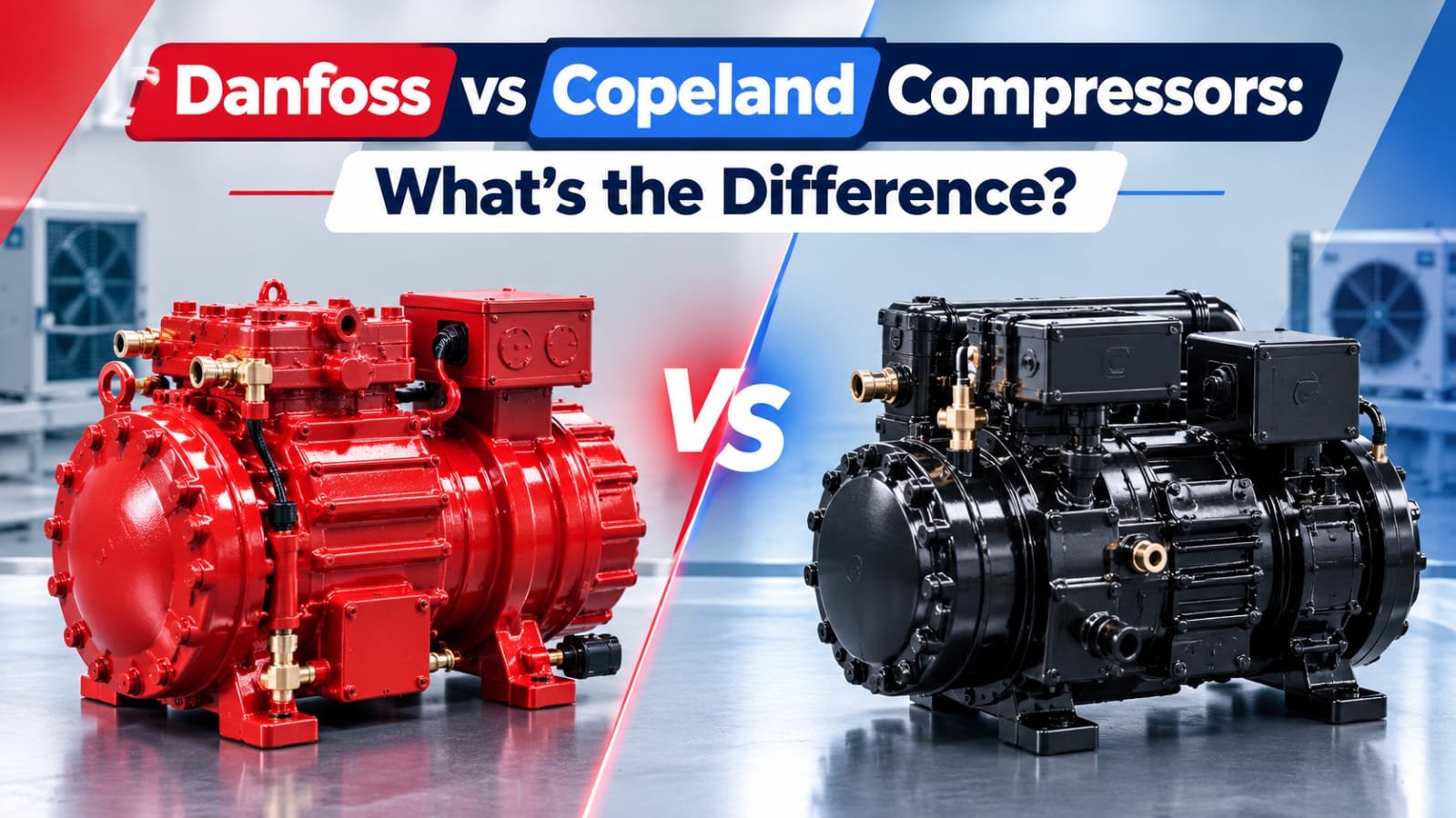
Danfoss vs Copeland Compressors: What’s the Difference?
Danfoss and Copeland are established names in the refrigeration and HVAC industry. Both offer compressor solutions for different cooling requirements, but the right choice depends on the application, required cooling capacity, operating conditions, refrigerant compatibility and system design.
If you are comparing Danfoss vs Copeland compressors for a commercial refrigeration system, cold room, supermarket or air-conditioning application, this guide explains the key differences and the factors to consider before choosing a compressor.
Danfoss vs Copeland Compressors: Quick Comparison
| Comparison Factor | Danfoss Compressors | Copeland Compressors |
|---|---|---|
| Product range | Includes scroll, reciprocating and other application-specific compressor technologies | Includes scroll, reciprocating and other compressor technologies for HVAC and refrigeration |
| Applications | Commercial refrigeration, cold rooms, display cabinets, air conditioning and other suitable applications | Commercial refrigeration, air conditioning, heat pumps and other suitable applications |
| Refrigerant compatibility | Depends on the specific compressor model and its approved refrigerants | Depends on the specific compressor model and its approved refrigerants |
| Cooling capacity | Varies by model, compressor type and operating conditions | Varies by model, compressor type and operating conditions |
| Energy efficiency | Must be evaluated using model-specific performance data | Must be evaluated using model-specific performance data |
| Selection criteria | Capacity, temperature range, refrigerant, electrical supply and system requirements | Capacity, temperature range, refrigerant, electrical supply and system requirements |
Important: Neither brand is automatically better for every application. Compare equivalent compressor models under the same operating conditions before making a purchasing decision.
What Are Danfoss Compressors?
Danfoss manufactures compressor solutions for commercial and light-commercial refrigeration, air conditioning and other cooling applications. Its product portfolio includes scroll and reciprocating compressors, along with specialised solutions for particular operating requirements.
Explore the available Danfoss compressor range to review relevant product options.
Depending on the series, Danfoss compressors can be used in applications such as cold rooms, commercial refrigerators, display cabinets, freezers and air-conditioning systems.
Key Considerations When Choosing a Danfoss Compressor
-
Application suitability: Confirm that the compressor is designed for the intended refrigeration or air-conditioning application.
-
Cooling capacity: Match the rated capacity to the system load and required operating conditions.
-
Refrigerant compatibility: Check the manufacturer’s approved refrigerants for the exact model.
-
Operating temperature: Verify the permitted evaporating and condensing conditions.
-
Electrical requirements: Confirm voltage, phase, frequency and starting requirements.
-
Efficiency: Compare performance data at equivalent operating conditions rather than relying on brand reputation alone.
Danfoss offers different compressor families for different requirements, so always check the relevant product datasheet before selecting a unit.
What Are Copeland Compressors?
Copeland provides compressor technologies for residential, commercial and industrial HVAC and refrigeration applications. Its portfolio includes scroll and reciprocating compressor solutions, with different models designed for specific system requirements.
Browse the Emerson Copeland compressor range to explore relevant product categories.
Depending on the model, Copeland compressors may be suitable for refrigeration equipment, commercial cooling systems, air conditioning and heat pump applications.
Key Considerations When Choosing a Copeland Compressor
-
Compressor technology: Identify whether the application requires a scroll, reciprocating or another suitable compressor type.
-
Cooling capacity: Check the rated capacity at the intended operating conditions.
-
Refrigerant: Confirm that the refrigerant is approved for the exact compressor model.
-
Electrical specifications: Verify supply voltage, phase, frequency and current requirements.
-
Operating envelope: Ensure the compressor can operate within the system’s expected temperature and pressure conditions.
-
Replacement compatibility: For replacement projects, verify the model number, mounting, connections, electrical requirements and manufacturer-approved alternatives.
Copeland also offers different product families for different applications. The specifications of one Copeland model should not be assumed to apply to the entire brand.
Danfoss vs Copeland: Which Compressor Is More Efficient?
Energy efficiency depends on the individual compressor model and how it operates within the complete refrigeration or air-conditioning system.
A meaningful comparison should consider:
-
Cooling capacity at the required operating point.
-
Power consumption under the same test conditions.
-
Evaporating and condensing temperatures.
-
Refrigerant type and system configuration.
-
Part-load performance, where relevant.
-
Expected operating hours and maintenance requirements.
Understanding the differences between scroll, rotary and reciprocating compressors can also help you identify which compressor technology may suit your application.
For example, a compressor with lower power consumption is not necessarily more efficient if it also provides less cooling capacity. Compare cooling output and power input under equivalent conditions before deciding.
Which Compressor Is Better for Your Application?
The right choice depends on your equipment and operating requirements.
For Commercial Refrigeration
For commercial refrigerators, display cabinets and similar equipment, check the required temperature range, cooling load, refrigerant and operating hours. Select a suitable Danfoss or Copeland model based on verified performance data.
For Cold Rooms and Cold Storage
Cold-room applications require careful matching of compressor capacity to the design load and operating temperatures. Check the intended evaporating temperature, condensing conditions, refrigerant and expected duty cycle before selecting a compressor.
For Air Conditioning
For air-conditioning applications, compare models specifically designed for the required duty. Cooling capacity, seasonal performance, operating conditions, electrical compatibility and system design should guide the decision.
For Compressor Replacement
If you are replacing an existing compressor, do not choose a replacement based on brand name or horsepower alone. Confirm the original model number, refrigerant, capacity, voltage, phase, frequency, operating envelope and connection requirements.
A qualified refrigeration technician or supplier should verify the replacement before installation. You can also review the Copeland CR36K6-PFZ reciprocating compressor as an example of a product page containing model-specific information. This is an example only, not a confirmed direct replacement for any Danfoss compressor.
How to Choose Between Danfoss and Copeland Compressors
Before purchasing, follow these steps:
-
Identify the application and required cooling capacity.
-
Confirm the operating temperature range and system conditions.
-
Check the refrigerant specified for the equipment.
-
Verify electrical specifications and installation requirements.
-
Compare manufacturer datasheets for equivalent operating conditions.
-
Consider availability, warranty, service support and total operating cost.
-
Confirm that the selected compressor is compatible with the complete system.
These checks help you choose a compressor based on technical suitability rather than assumptions about which brand is best.
Frequently Asked Questions
Are Danfoss compressors better than Copeland compressors?
Neither brand is universally better. The right choice depends on the compressor model, application, cooling capacity, refrigerant, operating conditions and efficiency requirements.
What is the difference between Danfoss and Copeland compressors?
Both brands offer multiple compressor technologies and product families. Their differences should be evaluated at the model level by comparing performance, approved refrigerants, operating envelopes, electrical requirements and application suitability.
Which compressor is suitable for a cold room?
The appropriate compressor depends on the cold room’s cooling load, required temperature, refrigerant, ambient conditions and system design. Compare models approved for those requirements before purchasing.
Can I replace a Danfoss compressor with a Copeland compressor?
A replacement may be possible, but it should not be assumed to be a direct fit. Confirm capacity, refrigerant, electrical specifications, operating envelope, connections and manufacturer-approved replacement guidance before installation.
How do I compare compressor efficiency?
Compare the cooling capacity and power consumption of candidate models at equivalent operating conditions. Use manufacturer datasheets or approved selection software for a reliable comparison.
Conclusion
Danfoss and Copeland both offer compressor solutions for a wide range of refrigeration and HVAC applications. The best option depends on the specific model and the requirements of your system—not the brand name alone.
Before purchasing, compare cooling capacity, refrigerant compatibility, operating conditions, electrical specifications and manufacturer performance data.
Need help selecting a suitable refrigeration compressor? Contact Compressor Refrigeration Pvt Ltd with your application details and existing compressor model so the requirements can be reviewed before purchase.