Top Benefits of Using Scroll Compressors in Commercial Refrigeration
Choosing a compressor for a commercial refrigeration system is not simply about selecting a well-known brand or the latest technology. The compressor must match the cooling load, refrigerant, operating temperatures and demands of the equipment it will serve.
Scroll compressors have become an important option in commercial refrigeration and HVAC because of their compact compression mechanism, smooth operation and potential for efficient performance under suitable operating conditions. However, not every scroll compressor is designed for every refrigeration application, and a scroll compressor is not automatically more economical than a reciprocating compressor in every installation.
This guide explains the main scroll compressor advantages, where refrigeration scroll compressors are used, how energy efficiency should be evaluated, and what buyers should check before choosing a model.
What is a Scroll Compressor?

A scroll compressor is a positive-displacement compressor that compresses refrigerant using two interleaved spiral-shaped elements. One scroll remains stationary while the other moves in an orbital motion without rotating on its own axis.
As refrigerant enters the compressor, pockets of gas form between the scrolls. These pockets move towards the centre and become progressively smaller, increasing the refrigerant pressure before discharge.
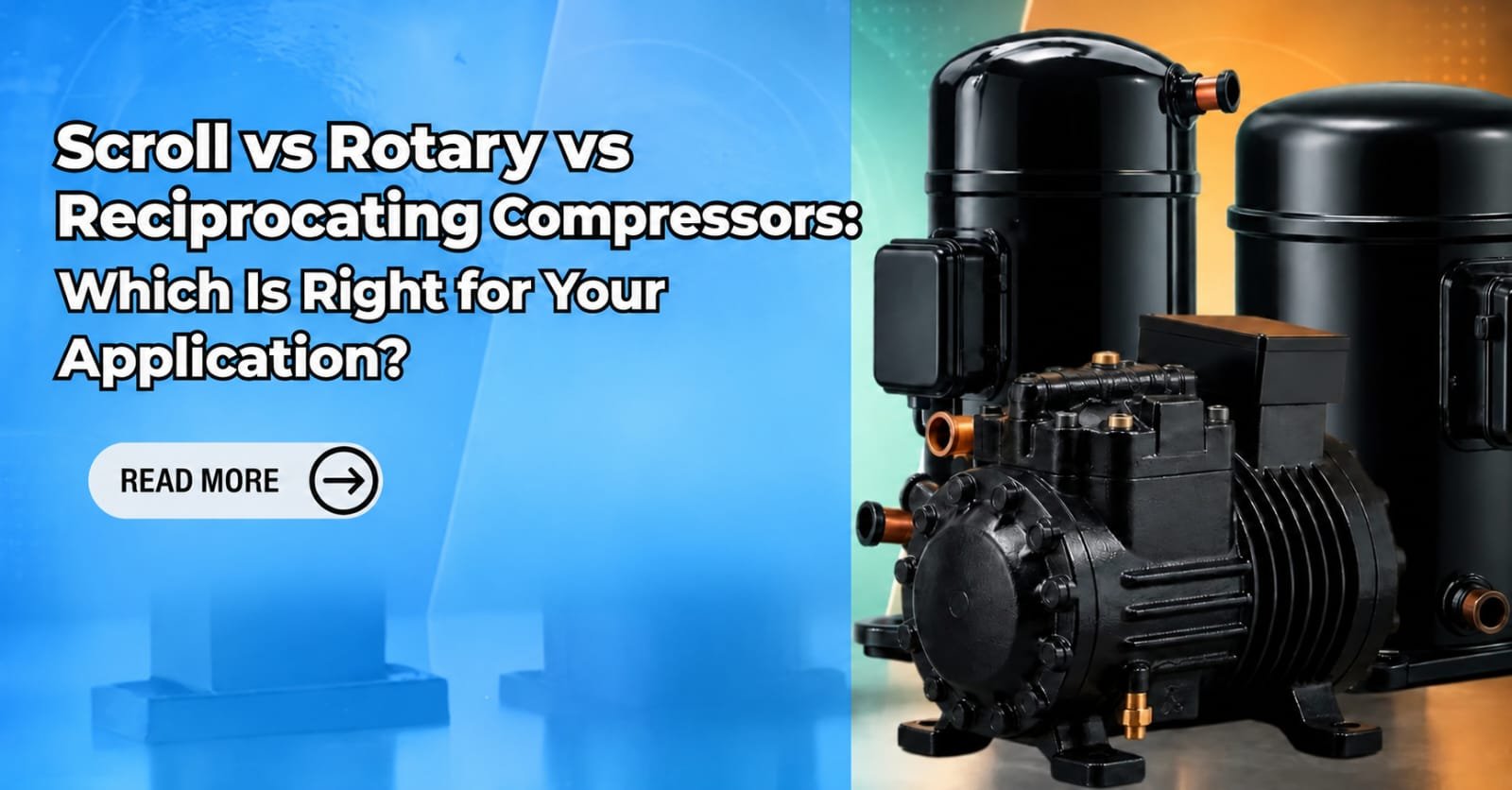
The continuous compression process is an important difference between scroll and reciprocating compressors, which use a piston moving inside a cylinder.
Scroll technology is used in residential and commercial air conditioning, refrigeration, heat pumps and selected industrial cooling applications. The correct application depends on the design of the individual compressor, not simply on the fact that it is a scroll compressor.
What Are the Main Scroll Compressor Advantages?
The main potential advantages of scroll compressors include efficient compression at suitable operating conditions, a compact design, smooth operation and relatively few moving components in the compression mechanism. How much these advantages matter depends on the application and the specific model.
. Potential for Energy-Efficient Operation
Energy efficiency is one of the most important reasons buyers consider scroll compressors for refrigeration. The scroll compression process can reduce certain pressure losses, and a well-matched compressor can deliver useful cooling performance without unnecessary power consumption.
However, the term “energy efficient scroll compressor” should be evaluated using actual performance data rather than the compressor type alone.
For a meaningful comparison, examine:
- Cooling capacity at the required evaporating and condensing conditions.
- Electrical power input at the same rated conditions.
- Refrigerant and compressor model.
- Expected refrigeration load and operating schedule.
- Performance during partial-load operation, where applicable.
A compressor that performs efficiently at one rating condition may not provide the same advantage across every operating condition. The performance of the complete refrigeration system also depends on the condenser, evaporator, expansion device, controls and installation.
Practical takeaway: Compare capacity and power-input data for the exact models under equivalent conditions. Do not assume a fixed percentage of electricity savings simply because one compressor uses scroll technology.
The ASHRAE Handbook chapter on compressors explains the engineering principles behind compressor performance and why compressor selection must account for the application’s design requirements.
2. Smooth Compression and Low-Pulsation Operation
Scroll compressors compress refrigerant through the orbital movement of the scroll elements. This creates a relatively continuous compression process rather than the individual piston strokes used in a reciprocating compressor.
The design can help reduce pressure pulsations and contribute to smooth operation. Low sound and vibration can be particularly useful in commercial buildings, retail equipment and other installations where operating noise matters.
Actual sound and vibration depend on the selected model, motor, mounting, refrigerant piping and system design. Poor installation can still produce unwanted vibration or noise.
3. Compact Design
A scroll compressor can offer a compact compression mechanism, which may help equipment designers make better use of the available space.
This can be useful in selected commercial refrigeration systems, packaged cooling equipment, chillers and HVAC installations where equipment dimensions and layout are important.
Compactness should still be assessed at the system level. The dimensions of the complete unit, pipe connections, electrical clearances, service access and condenser arrangement all influence the space required for installation.
4. Fewer Moving Components in the Compression Mechanism
Compared with many conventional reciprocating designs, scroll compressors have fewer moving components within the compression mechanism. This can reduce some sources of mechanical complexity.
The benefit should not be interpreted as a guarantee that every scroll compressor will last longer or require less maintenance than every reciprocating compressor. Reliability depends on the complete design, operating envelope, lubrication, refrigerant management and quality of installation.
For example, repeated liquid refrigerant return, unsuitable operating conditions or poor system control can damage a compressor regardless of its compression technology.
5. Options for Different Cooling Requirements
Refrigeration equipment manufacturers offer scroll-compressor ranges developed for different applications and operating conditions.
For example, Danfoss identifies its MLZ range for medium-temperature refrigeration applications and its LLZ range for low-temperature refrigeration applications. Some models also offer additional configurations intended to improve capacity or efficiency under specified conditions.
These product ranges demonstrate why choosing a compressor by its type alone is insufficient. Buyers need the exact model information, approved application range and performance data.
You can review the Danfoss refrigeration scroll-compressor range and the Copeland scroll-compressor portfolio for examples of how manufacturers distinguish products and applications.
Scroll Compressor Refrigeration Applications
Scroll compressors are used in several commercial refrigeration and HVAC applications. Suitability depends on the compressor series, refrigerant, required capacity and operating conditions.
Commercial refrigeration and cold rooms
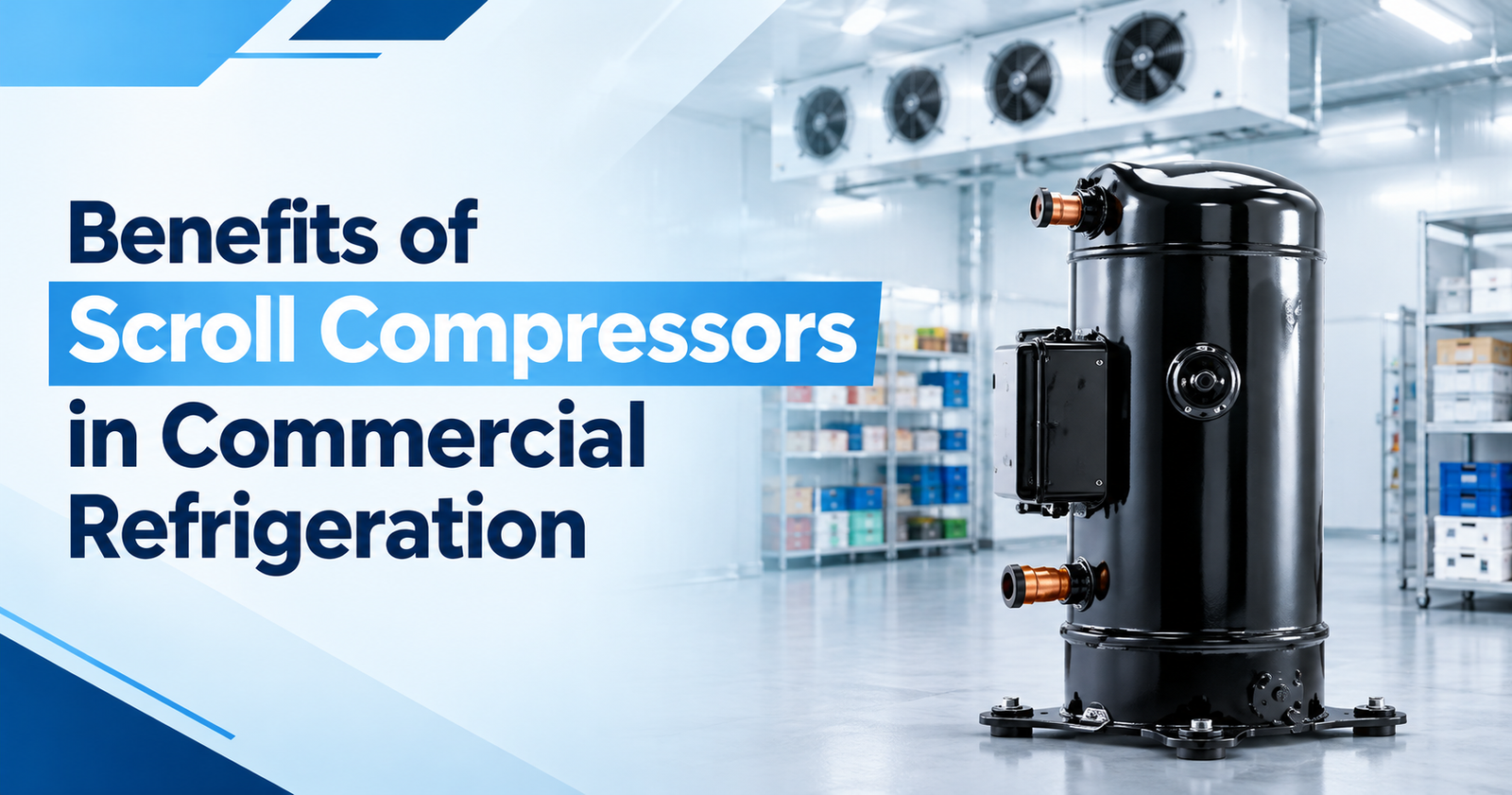
Selected refrigeration scroll compressors are used in cold rooms, walk-in coolers, food storage equipment and other commercial cooling systems.
The required room temperature is an important selection factor. A compressor designed for medium-temperature refrigeration should not automatically be assumed suitable for a low-temperature freezer.
Supermarkets and food retail
Refrigeration equipment in supermarkets and food retail environments must maintain the required product temperatures while responding to changes in cooling demand.
Scroll compressors can form part of suitable individual systems or multi-compressor arrangements. The complete system design determines how capacity is matched to demand.
Food processing and storage
Certain scroll-compressor ranges are designed for refrigeration applications involving food storage, cooling and selected processing systems.
The compressor must be selected according to the actual refrigeration duty. Blast freezing, standard cold storage and medium-temperature food cooling do not necessarily have the same requirements.
Commercial HVAC and chillers
Scroll compressors are widely used in commercial air conditioning and selected chiller applications. These systems may have different operating conditions from a dedicated low-temperature refrigeration installation.
This distinction matters when sourcing replacement compressors: a scroll compressor intended for air conditioning may not be an appropriate replacement for a refrigeration compressor.
Scroll Compressors for Refrigeration: What Should Buyers Check?
When choosing scroll compressors for refrigeration, start with the application rather than the brand name.
Before selecting a model, check the following technical details:
| Selection factor | Why it matters |
|---|---|
| Required cooling capacity | The compressor must provide the required refrigeration capacity at the actual operating conditions. |
| Refrigerant | Refrigerant compatibility must be confirmed for the exact model. |
| Evaporating and condensing conditions | These determine the pressure ratio and influence compressor performance. |
| Electrical supply | Voltage, phase and frequency must match the model’s specifications. |
| Operating temperature range | The compressor must be approved for the intended medium- or low-temperature duty. |
| Model and physical connections | Important for replacement compatibility and installation planning. |
| Product condition | New and refurbished units should be assessed according to their actual condition and documentation. |
| Warranty and availability | Confirm the terms offered for the specific unit before placing an order. |
Refrigerant compatibility deserves particular attention. Two scroll compressors from the same brand may have different approvals. A refrigerant should never be considered suitable simply because another model in the same product family supports it.
How to Evaluate an Energy-Efficient Scroll Compressor
For a business operating a cold room or commercial refrigeration facility, efficiency should be evaluated against the cooling duty the system must deliver.
A useful comparison includes three levels.
First, compare the compressors. Check the manufacturer’s cooling-capacity and power-input data at equivalent operating conditions.
Second, compare system performance. Look at condenser sizing, evaporator selection, expansion control, defrost operation, fan power and refrigeration load. These factors influence total electricity consumption.
Third, consider the operating schedule. A facility running continuously under a relatively steady load may have different requirements from a facility with frequent door openings, changing product loads or substantial variations in demand.
A compressor’s rated efficiency alone cannot predict a facility’s actual annual electricity use. A properly designed system can make a substantial difference to real-world performance.
Scroll vs Reciprocating Compressors for Large-Scale Cold Rooms
Comparing the energy efficiency of modern scroll compressors versus reciprocating compressors for large-scale cold-room facilities requires more than a general statement about which technology is better.
Both compressor types can be appropriate in refrigeration systems. The better option depends on the required capacity, operating temperatures, load profile, available models and system design.
| Comparison factor | Scroll compressor | Reciprocating compressor |
|---|---|---|
| Compression mechanism | Two interleaved scroll elements | Piston and cylinder |
| Operating characteristics | Continuous compression process | Piston-driven compression cycles |
| Mechanical design | Relatively few moving components in the compression mechanism | Includes pistons, connecting rods and associated components |
| Efficiency | Depends on the model and its operating conditions | Depends on the model and its operating conditions |
| Capacity requirements | Must match the required refrigeration duty | Must match the required refrigeration duty |
| Best selection method | Compare model-specific data and system suitability | Compare model-specific data and system suitability |
What about large cold rooms in the UK?
For a large cold-room facility in the UK, the appropriate comparison should use the actual cooling requirement, required room temperature, local design conditions and expected operating schedule. The same engineering approach applies to projects in India and the Gulf region.
Danfoss has published a walk-in cooler discussion that reports lower energy consumption for some scroll-compressor models than for reciprocating alternatives under laboratory conditions. That is a manufacturer-reported example, not a universal energy-saving guarantee for every cold room or compressor pairing.
Before using such a comparison to estimate operating-cost savings, confirm the models tested, the cooling duty, the test conditions and the method used to measure energy consumption.
For a large installation, the decision should be based on suitable technical data and a complete system assessment—not a headline efficiency percentage.
What Is Shaping the Scroll Compressor Market?
The scroll compressor market includes products for several different applications, including commercial refrigeration, air conditioning, heat pumps and selected industrial cooling systems.
This is not a single uniform product category. Compressor capacity, refrigerant approvals, operating temperature ranges, control options and application requirements vary between product families.
For a buyer, market trends are only one part of the decision. A model that is popular in air conditioning, for example, may not be appropriate for a low-temperature refrigeration application.
When comparing market reports or product options, check which application segment, region, product type and reporting period the information covers. Market-wide claims should not be used as a substitute for model-specific technical selection.
Scroll Compressors in Hot Climates: India and the Gulf
For refrigeration projects in India and Gulf countries, ambient temperature and condenser performance deserve careful consideration.
As the ambient temperature increases, a conventional air-cooled condenser may need to operate at a higher condensing temperature and pressure to reject heat. This changes the conditions under which the compressor works and can affect capacity, power input and operating limits.
A scroll compressor should therefore not be selected for a hot climate simply because scroll technology is often associated with efficient operation.
Before specifying a model for a high-ambient installation, review:
- The manufacturer’s approved operating envelope.
- Cooling capacity and power input at the expected operating conditions.
- Condenser sizing and the availability of adequate airflow.
- Refrigerant compatibility and the required system controls.
- Protection settings and the equipment manufacturer’s installation requirements.
The correct choice is the model that meets the refrigeration duty within its approved operating range. Local climate and installation requirements should be considered during system design.
How to Choose a Suitable Scroll Compressor for Replacement
Replacing a failed compressor requires more than finding another unit with a similar size or nominal horsepower.
Start by recording the existing compressor’s complete model number. Then confirm the required refrigerant, electrical ratings, capacity, operating temperature range and approved application.
If the original model is unavailable, a proposed alternative should be checked against the manufacturer’s technical data and the requirements of the complete system. Physical dimensions alone do not establish that two compressors are interchangeable.
For refurbished compressors, also confirm the unit’s condition, available documentation, applicable warranty terms and return or replacement conditions before ordering.
These checks help reduce the risk of purchasing a compressor that cannot perform properly in the intended application.
Frequently Asked Questions
Q1. What are the main advantages of scroll compressors?
The main potential advantages include a compact compression mechanism, smooth operating characteristics, relatively few moving components and efficient performance under suitable conditions. Actual results depend on the model and application.
Q2. Are scroll compressors suitable for refrigeration?
Yes, selected scroll-compressor ranges are designed specifically for commercial refrigeration. Buyers must confirm that the model supports the required refrigerant, temperature range and cooling capacity.
Q3. Is an energy-efficient scroll compressor always better than a reciprocating compressor?
Some scroll compressors are designed for medium-temperature or low-temperature refrigeration and can be used in suitable cold-room systems. The correct choice depends on the required room temperature, capacity, refrigerant and compressor operating limits.
Q4.Can every scroll compressor use R-410A, R-32 or R-454B?
No. Refrigerant compatibility varies by compressor model and product family. Check the current manufacturer’s documentation before using or specifying a refrigerant. Do not assume that a model supports a refrigerant because another scroll compressor does.
Q5.Do scroll compressors always require less maintenance?
Not necessarily. Their compression mechanism has relatively few moving components, which can be an advantage. However, maintenance needs and service life depend on the design, operating conditions, installation, lubrication and refrigerant management.
Q6.How can I compare scroll and reciprocating compressors for a large cold room?
Compare the exact models at equivalent operating conditions. Review cooling capacity, power input, refrigerant, load profile and the design of the complete refrigeration system. Avoid applying a general efficiency percentage to a different installation without supporting evidence.
Buying Scroll Compressors for Commercial Refrigeration
Compressor Refrigeration Pvt Ltd is a Delhi-based supplier of refrigeration and HVAC compressors. Businesses looking for scroll compressors can review the available models and product details in our existing category.
When enquiring, share the compressor model number, required quantity, refrigerant, application and electrical specifications. These details help identify which available models may be suitable for your requirements.
Browse the Scroll Compressor category to review available products. Confirm the specific model, current availability, condition and applicable warranty terms before placing an order.
Conclusion
Scroll compressors offer useful advantages for suitable refrigeration and HVAC applications, particularly where their compression design, operating characteristics and available product range match the system requirements.
Businesses evaluating refrigeration equipment should compare different compressor types and brands according to their cooling requirements and operating conditions. Explore our range of refrigeration compressors, reciprocating compressors, Danfoss compressors and Emerson Copeland compressors to identify relevant options for your application.
For model availability, compatibility checks or quotations, contact our team with your required compressor model and quantity.