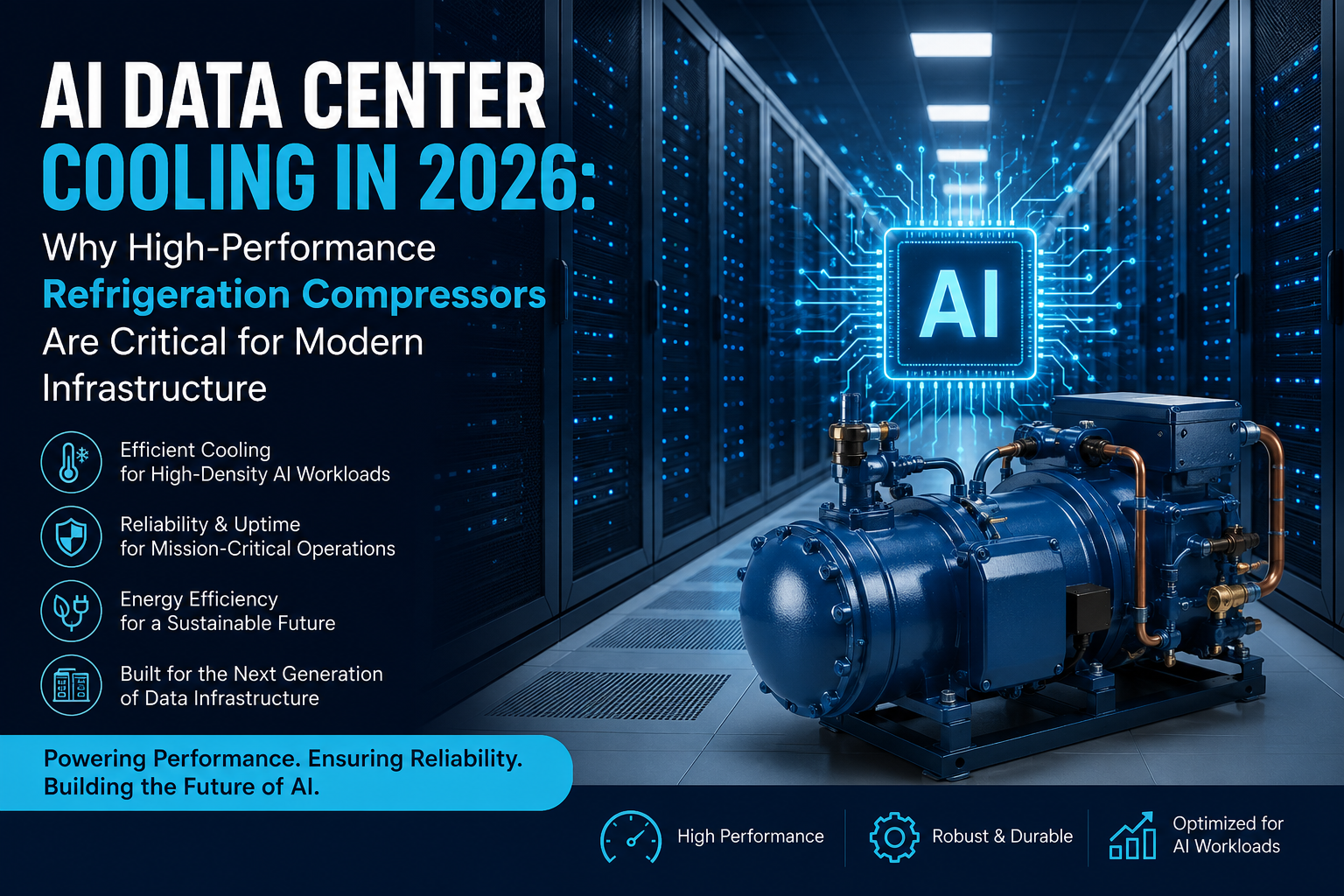
AI Data Center Cooling in 2026: Why High-Performance Refrigeration Compressors Are Critical for Modern Infrastructure
The ai data center cooling boom has changed the shape of the data center industry. Racks that once drew 5 to 10 kW now regularly exceed 40 to 100 kW, and the compute clusters behind large language models push density even higher. This shift has turned cooling from a background utility into one of the most strategic engineering decisions a facility can make.
At the center of that decision sits a component that rarely gets the spotlight: the refrigeration compressor. Whether a facility relies on chilled water plants, direct expansion (DX) systems, or hybrid liquid cooling loops, the compressor is the mechanical heart that moves heat out of the building. Get the compressor selection wrong, and no amount of clever airflow design or liquid cooling plumbing will save the facility from thermal throttling, downtime, or runaway energy bills.
This guide walks through what AI infrastructure actually is, why AI servers generate so much heat, how cooling architectures have evolved, and — most importantly — how to select, size, and maintain the refrigeration compressors that keep these facilities running. It is written for HVAC contractors, MEP engineers, data center consultants, and facility managers who need practical, technically grounded guidance rather than marketing fluff.
1. What Is AI Infrastructure?
AI infrastructure refers to the combined hardware, networking, power, and cooling systems required to train and run artificial intelligence models at scale. It includes GPU and accelerator clusters, high-speed interconnects, storage arrays, power distribution units, and the thermal management systems that keep all of it within safe operating temperatures.
Unlike traditional enterprise IT infrastructure, which is built around general-purpose CPUs handling varied workloads, AI infrastructure is purpose-built around parallel processing units — primarily GPUs and specialized AI accelerators — that are optimized for matrix multiplication and tensor operations. This specialization is what makes AI training and inference so powerful, but it is also exactly why the thermal footprint is so different.
Three layers typically make up AI infrastructure:
- Compute layer: GPUs, TPUs, and AI accelerators arranged in dense server racks or “pods.”
- Network layer: High-bandwidth, low-latency interconnects (such as InfiniBand or high-speed Ethernet) that let thousands of processors work together.
- Facility layer: Power delivery, backup systems, and — critically — the cooling infrastructure that removes heat generated by the compute layer.
For HVAC contractors and MEP engineers, understanding this layered structure matters because cooling decisions are no longer isolated. A change in rack density on the compute layer cascades directly into chiller plant sizing, compressor selection, and piping design on the facility layer.
2. What Are AI Data Centers?
AI data centers are purpose-built or retrofitted facilities designed specifically to host GPU-dense compute clusters used for training and running AI models. They differ from conventional data centers in power density, cooling architecture, and physical layout.
A conventional enterprise data center might be designed around 5–10 kW per rack. An AI training facility, by contrast, is often designed around 40–100+ kW per rack, with some hyperscale GPU pods pushing well beyond that as next-generation accelerators ship. This density difference is the single biggest driver behind the redesign of cooling systems across the industry.
Key Characteristics of AI Data Centers
| Characteristic | Conventional Data Center | AI Data Center |
| Typical rack density | 5–10 kW | 40–100+ kW |
| Primary cooling method | Air cooling (CRAC/CRAH) | Liquid cooling, immersion, or hybrid |
| Compressor duty cycle | Moderate, cyclical | Continuous, high-load |
| Redundancy requirements | N+1 typical | N+1 or 2N common due to criticality |
| Floor design | Raised floor, hot/cold aisle | Reinforced floor, rear-door heat exchangers, liquid manifolds |
| Power infrastructure | Standard UPS/PDU | High-density PDU, often DC experiments |
AI data centers also tend to cluster geographically near cheap and reliable power, and increasingly near locations where waste heat can be reused or where ambient conditions assist free cooling for part of the year. For Gulf region facilities — UAE, Saudi Arabia, Qatar, Kuwait, Oman, and Bahrain — high ambient temperatures make mechanical refrigeration, rather than free cooling, the primary workhorse for most of the year, which places even greater importance on compressor reliability and efficiency.
3. Why AI Servers Generate Massive Heat
AI servers generate significantly more heat than traditional servers because GPUs and AI accelerators pack far more transistors into a smaller die area and run at sustained high utilization, rather than the intermittent bursts typical of general-purpose computing.
A few factors compound this heat generation:
- Sustained high utilization — training runs can keep GPUs at 90–100% utilization for days or weeks, unlike enterprise servers that idle frequently.
- Power density per chip — modern AI accelerators draw hundreds of watts each, and a single server may house eight or more of them.
- Tight physical packing — to minimize interconnect latency, GPUs are packed close together, concentrating heat in a small volume.
- Parallel scaling — training large models requires thousands of chips working in synchrony, multiplying the aggregate heat load.
The practical result is that airflow alone often cannot remove heat fast enough from the densest racks, which is why liquid cooling and immersion technologies have moved from niche experiments to mainstream deployment in AI-focused facilities.
4. Cooling Challenges in AI Facilities
- Thermal density mismatch: existing buildings designed for 5–10 kW racks often cannot support 40+ kW racks without significant retrofit of piping, floor loading, and airflow paths.
- Redundancy under high load: unplanned cooling downtime is far costlier than in general-purpose facilities, raising the bar for compressor reliability and backup capacity.
- Water availability and sustainability pressure: liquid-cooling-heavy designs raise questions about water sourcing, pushing interest toward closed-loop and dry-cooling compressor systems.
- Noise and vibration: high-speed compressors and pumps operating continuously introduce vibration and noise considerations in dense urban sites.
- Refrigerant transition: global phase-down of high-GWP refrigerants is pushing suppliers toward next-generation refrigerants, affecting compressor compatibility and retrofits.
- Skilled labor shortage: few HVAC contractors have direct experience with the compressor duty cycles unique to AI-density facilities.
5. Traditional Cooling vs Modern Cooling
Traditional data center cooling was built around a simple principle: circulate cold air through a raised floor, let it absorb heat from server intakes, and return warm air to a CRAC or CRAH unit for cooling and recirculation.
Modern AI-ready cooling takes a fundamentally different approach because air simply cannot carry enough heat away from the densest racks fast enough. The table below summarizes the shift.
| Factor | Traditional Cooling | Modern (AI-Ready) Cooling |
| Heat transfer medium | Air | Liquid (water/glycol) or dielectric fluid |
| Typical density supported | Up to ~15 kW/rack | 40–100+ kW/rack |
| Compressor duty | Cyclical, moderate load | Near-continuous, high load |
| Control approach | Fixed-speed staging | Variable-speed, sensor-driven |
| Efficiency metric focus | PUE | PUE plus WUE (Water Usage Effectiveness) |
| Maintenance approach | Scheduled/reactive | Predictive, IoT-enabled |
The takeaway for buyers: a compressor system specified for a traditional facility rarely transfers cleanly to an AI-density retrofit. Sizing, refrigerant choice, and control logic all need re-evaluation.
6. Air Cooling, Liquid Cooling, and Immersion Cooling Compared
Air Cooling
Air cooling remains the default for lower-density AI inference workloads and mixed-use facilities. It relies on CRAC/CRAH units, hot/cold aisle containment, and — behind the scenes — refrigeration compressors driving the DX or chilled water loop that conditions the supply air.
Advantages: lower upfront capital cost, familiar to most facility teams, easier to retrofit, no risk of liquid near electronics.
Limitations: struggles above roughly 20–25 kW per rack without supplemental cooling, higher fan energy at high airflow rates, larger footprint for equivalent heat removal.
Liquid Cooling
Liquid cooling includes both direct-to-chip (cold plates circulating coolant directly over the GPU/CPU) and rear-door heat exchangers that capture heat at the rack level before it enters the room.
Advantages: handles much higher rack densities than air alone, improves overall energy efficiency, reduces fan energy and noise inside the white space.
Limitations: higher installation complexity and cost, requires careful leak detection, and the compressor/chiller plant must be sized for continuous, high-load operation.
Immersion Cooling
Immersion cooling submerges servers directly in a dielectric fluid, removing heat at the source with no air gap at all.
Advantages: extremely high heat removal capacity per unit volume, can significantly reduce fan and airflow-related energy use, well suited to the densest AI training pods.
Limitations: requires specialized server hardware and fluid handling, higher upfront investment, and a smaller pool of experienced contractors.
Pros & Cons Summary Table
| Cooling Method | Best For | Compressor Load Profile | Relative Cost |
| Air Cooling | Low-to-mid density, mixed workloads | Cyclical | Low |
| Liquid Cooling | High-density AI training/inference | Continuous, high | Medium–High |
| Immersion Cooling | Ultra-high-density AI training pods | Continuous, sustained high | High |
Regardless of which method a facility chooses, every one of them ultimately depends on a mechanical refrigeration cycle somewhere upstream. This is why compressor quality and selection remain foundational no matter which cooling architecture wins on paper.
7. The Role of Refrigeration Compressors in Data Center Cooling
The refrigeration compressor is the component that pressurizes refrigerant vapor, enabling the entire vapor-compression cycle that removes heat from a data center’s cooling loop and rejects it outside the building.
In a typical vapor-compression cycle relevant to data center cooling:
- The compressor draws in low-pressure refrigerant vapor from the evaporator.
- It compresses that vapor, raising its pressure and temperature.
- The hot, high-pressure vapor moves to the condenser, where it rejects heat to outside air or a cooling tower loop.
- The refrigerant condenses to liquid and passes through an expansion valve, dropping in pressure and temperature.
- The cold liquid refrigerant enters the evaporator, absorbs heat, and returns to the compressor as vapor to repeat the cycle.
In AI-density facilities, this cycle runs almost continuously, which is why compressor selection criteria shift toward continuous-duty reliability, part-load efficiency, and variable-speed control rather than simply peak capacity.
For B2B buyers — EPC companies, HVAC contractors, and facility managers — the compressor is not a commodity line item. It is a long-term reliability investment that directly determines uptime for a facility whose entire business model depends on uninterrupted compute availability.
8. Types of Compressors Used in Data Center Cooling
Scroll Compressors
Scroll compressors use two interleaving spiral (scroll) elements to compress refrigerant smoothly, without the pulsation typical of reciprocating designs. They are widely used in precision air conditioning (PAC) units, rooftop packaged units, and smaller chiller modules serving edge or colocation data centers.
Why they matter: high reliability, few moving parts, quiet operation, and strong part-load efficiency.
Rotary Compressors
Rotary compressors — including rolling piston and rotary vane designs — are compact, efficient, and common in smaller precision cooling units, in-row coolers, and packaged DX systems for edge computing nodes.
Why they matter: compact footprint and smooth operation suit space-constrained deployments such as micro data centers and containerized compute pods.
Reciprocating Compressors
Reciprocating (piston) compressors remain common in larger commercial and industrial refrigeration applications, including legacy chiller plants.
Why they matter: robust performance across a wide range of conditions, though newer scroll and screw designs have captured much of this segment in modern builds.
Variable Speed (Inverter-Driven) Compressors
Variable speed compressors — including DC inverter scroll and inverter-driven screw compressors — adjust their speed continuously to match real-time cooling demand rather than cycling on and off at fixed capacity.
This is arguably the most important compressor development for AI-density cooling: precise demand tracking delivers major efficiency gains, reduces mechanical wear from frequent starts/stops, and improves temperature stability for sensitive GPU hardware.
Compressor Comparison Table
| Compressor Type | Typical Application | Part-Load Efficiency | Noise Level | Maintenance Complexity |
| Scroll | Precision cooling, rooftop units | Good | Low | Low |
| Rotary | Edge/micro data centers | Good | Low | Low |
| Reciprocating | Larger chiller plants, legacy systems | Moderate | Moderate | Moderate |
| Variable Speed | High-density AI facilities | Excellent | Low | Moderate |
Facilities frequently combine compressor types across their cooling architecture. Sourcing partners who understand both product lines and application requirements — rather than pushing a single product — deliver more reliable long-term outcomes for MEP teams designing these hybrid systems.
9. Energy Efficiency in Compressor-Based Cooling
Cooling is consistently one of the largest components of a data center’s total energy bill, which is why organizations such as ASHRAE, the U.S. Department of Energy, and ENERGY STAR publish guidance and standards around data center thermal management and efficiency metrics like PUE.
How Compressor Choice Affects Efficiency
- Variable-speed operation: matches output precisely to load, avoiding the waste of fixed-speed units cycling against a load that rarely matches their fixed capacity.
- High part-load efficiency: matters more than peak-load efficiency for most facilities, since AI data centers rarely run at exactly 100% design capacity every hour.
- Refrigerant selection: affects both efficiency and long-term regulatory compliance as the industry shifts toward lower-GWP refrigerants.
- Proper sizing: avoids the efficiency penalty of an oversized compressor short-cycling or an undersized one running constantly at maximum strain.
Efficiency Best Practices Checklist
☐ Match compressor capacity to actual measured heat load, not just nameplate IT equipment ratings
☐ Prioritize variable-speed compressors for facilities with fluctuating AI training/inference loads
☐ Evaluate part-load efficiency curves, not just peak EER/COP ratings
☐ Confirm refrigerant compatibility with current and upcoming regional regulations
☐ Pair compressor selection with economizer/free-cooling strategies where climate allows
☐ Review manufacturer data on compressor lifecycle energy cost, not just purchase price
10. Predictive Maintenance, Smart Monitoring, and IoT Integration
Predictive maintenance uses real-time sensor data and analytics to anticipate compressor failures before they happen, rather than relying on fixed maintenance schedules or reacting after a breakdown.
How IoT Integration Supports Compressor Reliability
- Vibration sensors detect early bearing wear or mechanical imbalance before it escalates into a failure.
- Temperature and pressure sensors across the refrigerant loop flag abnormal operating conditions that often precede a fault.
- Current and power monitoring on compressor motors can reveal early signs of electrical or mechanical stress.
- Cloud-connected dashboards aggregate data across multiple units, letting facility managers prioritize maintenance sitewide.
- Automated alerting notifies maintenance teams the moment a reading crosses a defined threshold.
Smart Monitoring Benefits
- Reduced unplanned downtime
- Extended compressor service life through early intervention
- Better spare parts planning and inventory management
- Data-backed capacity planning for future expansions
- Improved warranty compliance through documented maintenance history
11. AI-Based Optimization of Cooling Systems
It’s a fitting irony that artificial intelligence — the very workload driving the need for advanced cooling — is also being used to optimize the cooling systems that support it. AI-based building management systems increasingly use machine learning models to:
- Predict thermal load: minutes or hours ahead based on scheduled workloads, allowing compressors to pre-adjust rather than react.
- Optimize compressor staging and speed: across multiple units to minimize total energy consumption while maintaining setpoint temperatures.
- Balance liquid and air cooling loops: dynamically in hybrid facilities, shifting load between systems as conditions change.
- Identify efficiency drift: over time, flagging when a compressor’s real-world performance has degraded from its baseline.
This places even greater importance on compressors with strong variable-speed control interfaces and robust sensor integration, since these are the components an AI optimization layer actually manipulates.
12. Future Trends in Data Center Cooling (2026–2035)
- Wider adoption of direct-to-chip and hybrid liquid cooling as rack densities continue climbing with next-generation AI accelerators.
- Continued refrigerant transition toward lower-GWP options, driven by international phase-down agreements and regional regulations.
- Growth of heat reuse projects, where waste heat captured from data center cooling loops is redirected to district heating or industrial processes.
- Greater standardization of variable-speed, digitally controlled compressors as the default rather than the premium option.
- Expansion of modular and containerized data centers, particularly for edge AI inference, favoring compact rotary and scroll compressor platforms.
- Increased scrutiny of Water Usage Effectiveness (WUE) alongside PUE, especially in water-stressed regions.
- Deeper AI-driven predictive maintenance integration, moving from pilot programs to standard practice across hyperscale and colocation operators.
For buyers and specifiers, the practical implication is straightforward: compressor and cooling system decisions made today should account for refrigerant transition timelines and increasing density requirements, not just current-day loads.
13. Buying Guide: Selecting the Right Compressor
Choosing a compressor for a data center cooling application requires balancing several technical and commercial factors.
Selection Factors
| Factor | Why It Matters | Key Question to Ask a Supplier |
| Cooling capacity | Must match actual heat load, not just IT nameplate rating | What is the capacity at your design ambient temperature? |
| Speed control | Variable-speed units handle fluctuating AI loads far better | Is this fixed-speed or inverter/variable-speed? |
| Refrigerant compatibility | Affects efficiency, compliance, and future retrofits | Which refrigerants is it rated for, now and going forward? |
| Duty cycle rating | AI cooling runs near-continuously | Is this compressor rated for continuous-duty operation? |
| Brand and build quality | Long-term reliability reduces total cost of ownership | What brand and warranty terms apply? |
| Noise and vibration | Matters for co-located or urban sites | What are the published sound/vibration specs? |
| Availability and lead time | Delays can stall commissioning schedules | What is current stock availability and lead time? |
| After-sales support | Reduces downtime risk over the service life | What technical and spare parts support is available? |
Step-by-Step Buying Process
- Calculate the actual thermal load of the racks or zone the compressor will serve, including future expansion headroom.
- Choose the cooling architecture (air, liquid, immersion, or hybrid) based on density and facility constraints.
- Shortlist compressor types that match that architecture — scroll, rotary, reciprocating, or variable-speed inverter models.
- Verify refrigerant compatibility against current regulations and expected future changes.
- Request performance data across part-load conditions, not just peak-load specifications.
- Confirm duty cycle rating matches the near-continuous operation typical of AI workloads.
- Evaluate the supplier, not just the product — check brand authenticity, export documentation, and after-sales technical support.
- Plan for redundancy (N+1 or 2N) appropriate to the criticality of the workload being cooled.
- Confirm lead times and logistics, especially for imported units destined for time-sensitive commissioning schedules.
- Document maintenance requirements upfront so facility teams can budget for predictive maintenance tooling from day one.
Buying Checklist
☐ Thermal load calculated with future growth margin
☐ Cooling architecture selected and validated against building constraints
☐ Compressor type matched to duty cycle and density
☐ Refrigerant type confirmed against current and upcoming regulations
☐ Variable-speed control evaluated for efficiency gains
☐ Supplier brand authenticity and documentation verified
☐ Redundancy level (N+1/2N) defined
☐ Warranty and after-sales support terms confirmed
☐ Export/import logistics and lead times confirmed for cross-border projects
☐ Maintenance plan and monitoring strategy established before commissioning
14. Common Mistakes to Avoid
- Sizing compressors to nameplate IT load instead of actual measured heat output, leading to oversized, inefficient systems.
- Choosing fixed-speed compressors for highly variable AI workloads, sacrificing significant energy efficiency.
- Ignoring refrigerant regulatory timelines, resulting in premature obsolescence or costly retrofits.
- Underestimating redundancy needs for mission-critical AI training clusters where downtime is extremely costly.
- Overlooking part-load efficiency data in favor of headline peak-capacity numbers.
- Failing to plan for predictive maintenance from day one, missing early warning signs of compressor degradation.
- Sourcing from unverified suppliers, risking counterfeit or mislabeled compressor units.
- Neglecting noise and vibration specifications in co-located or urban-adjacent facilities.
- Treating compressor selection as a one-time decision rather than planning for future density increases.
- Skipping proper commissioning and control sequence verification, which can leave even a well-chosen compressor underperforming.
15. Maintenance Tips and Schedules
Consistent maintenance is what separates a compressor that reaches its full rated service life from one that fails early under continuous AI-density duty cycles.
Expert Maintenance Tips
- Keep detailed logs of suction and discharge pressures to catch gradual drift before it becomes a fault.
- Verify refrigerant charge levels regularly rather than only when a problem is suspected.
- Inspect and clean condenser coils on a fixed schedule, since fouled coils force compressors to work harder and run hotter.
- Monitor compressor motor current draw as an early indicator of mechanical or electrical stress.
- Keep a documented maintenance history for warranty compliance and resale/upgrade planning.
- Train facility staff specifically on the control sequences of variable-speed compressors.
Sample Maintenance Schedule
| Task | Frequency | Priority |
| Visual inspection of compressor and piping | Weekly | High |
| Vibration and noise check | Monthly | High |
| Refrigerant pressure and charge verification | Monthly | High |
| Condenser coil cleaning | Quarterly | High |
| Electrical connection and current draw check | Quarterly | Medium |
| Oil analysis (where applicable) | Semi-annually | Medium |
| Full performance benchmarking vs. baseline | Annually | High |
| Control system and sensor calibration check | Annually | Medium |
16. Real-World Applications
- Hyperscale AI training campuses: increasingly deploy hybrid architectures combining direct-to-chip liquid cooling for GPU racks with traditional air cooling for supporting infrastructure, all backed by chiller plants using variable-speed compressors.
- Colocation providers: retrofitting existing facilities to host AI tenants often add supplemental precision cooling units with scroll or rotary compressors to specific high-density zones.
- Edge AI inference nodes: deployed closer to end users for lower latency, favor compact rotary and scroll compressor-based packaged units due to space constraints.
- Cold storage and industrial refrigeration facilities: that also host IT equipment on-site benefit from suppliers who understand both commercial refrigeration and precision cooling requirements.
- EPC companies delivering turnkey data center projects: rely on compressor suppliers who can provide consistent, verified stock across multiple brands to avoid project delays.
Frequently Asked Questions
What is AI data center cooling?
AI data center cooling refers to the thermal management systems — air, liquid, or immersion-based — designed to remove the significantly higher heat loads generated by GPU-dense AI training and inference infrastructure compared to traditional servers.
Why do AI servers generate more heat than regular servers?
AI servers use GPUs and accelerators that run at sustained high utilization with dense chip packing, unlike traditional CPUs that idle frequently, resulting in much higher and more continuous heat output per rack.
What role do refrigeration compressors play in data center cooling?
The compressor drives the vapor-compression refrigeration cycle that removes heat from chilled water or DX cooling loops and rejects it outside the building, making it the core mechanical component behind nearly every cooling architecture.
Which compressor type is best for data centers?
Variable-speed (inverter-driven) scroll compressors are generally best suited to AI data centers due to their ability to match continuously fluctuating cooling loads efficiently, though rotary and reciprocating types remain appropriate for specific applications.
What is the difference between air cooling and liquid cooling?
Air cooling uses circulated air to remove heat from server intakes, while liquid cooling uses water, glycol, or dielectric fluid to capture heat directly at the chip or rack level, supporting much higher densities than air alone.
Is immersion cooling suitable for all data centers?
No. Immersion cooling suits ultra-high-density AI training pods but requires specialized hardware, fluid handling expertise, and higher upfront investment, making it less practical for lower-density or mixed-use facilities.
How does compressor duty cycle differ in AI facilities versus traditional data centers?
AI facilities typically require near-continuous compressor operation due to sustained high thermal loads, whereas traditional data centers often see more cyclical, on/off compressor operation.
What is PUE and why does it matter for cooling system design?
PUE (Power Usage Effectiveness) measures total facility energy use against IT equipment energy use; efficient compressor selection directly lowers PUE by reducing the energy overhead required for cooling.
What is predictive maintenance for compressors?
Predictive maintenance uses sensor data — vibration, temperature, pressure, and current draw — combined with analytics to flag developing compressor issues before failure, rather than relying on fixed schedules alone.
Conclusion
AI has permanently changed what “adequate cooling” means for a data center. Rack densities that were once considered extreme are now common, and the mechanical infrastructure behind the walls — chillers, precision cooling units, and above all, refrigeration compressors — now carries more responsibility for uptime than ever before.
Getting this right requires more than picking a compressor off a spec sheet. It means understanding actual thermal loads, matching compressor technology to duty cycle, planning for refrigerant transitions, and partnering with suppliers who can be trusted on both product authenticity and technical support.
For HVAC contractors, MEP engineers, facility managers, and EPC teams building or retrofitting AI-ready facilities, the compressor is not a commodity purchase — it is a long-term reliability decision that shapes energy costs, uptime, and total cost of ownership for the life of the facility.