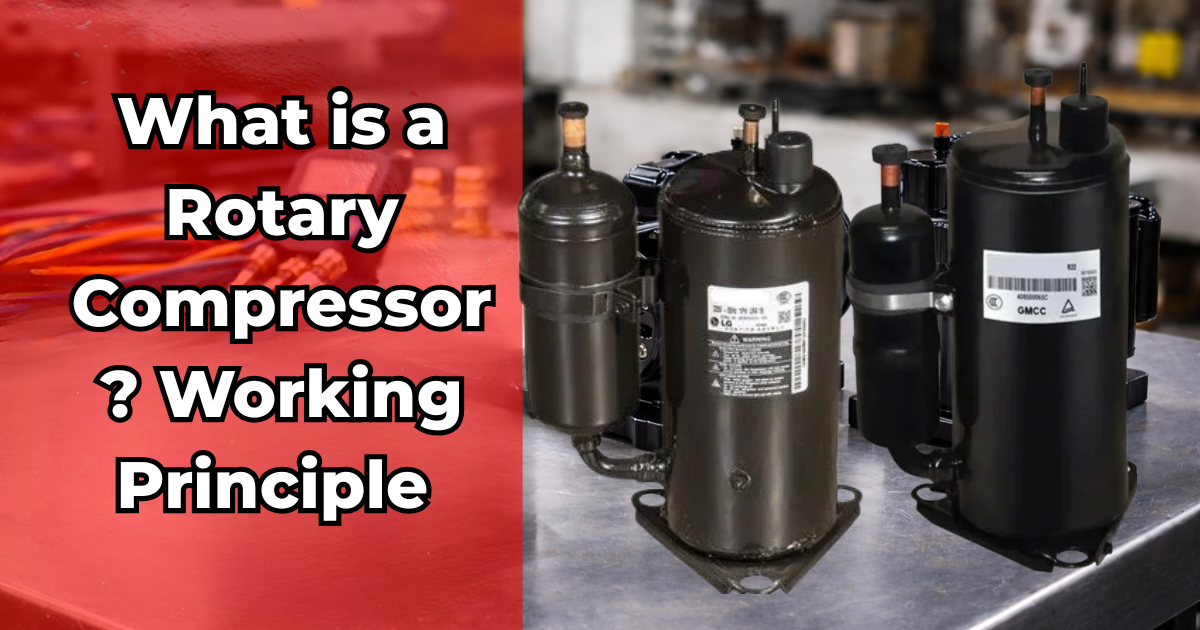
If you’ve ever wondered what keeps your split air conditioner humming quietly through a sweltering Indian summer, the answer lies in a small but powerful component: the rotary compressor. One of the most widely used compressor types in modern HVAC and refrigeration systems, the rotary compressor has earned its place at the heart of cooling technology thanks to its compact design, energy efficiency, and reliable performance.
Understanding what is a rotary compressor — and how it works — is essential knowledge for HVAC technicians, refrigeration engineers, contractors, and anyone procuring cooling equipment for commercial or industrial use. This guide covers everything you need to know, from the rotary compressor working principle to real-world applications of rotary compressor, cost factors, and how to choose the right unit for your system.
What is a Rotary Compressor?
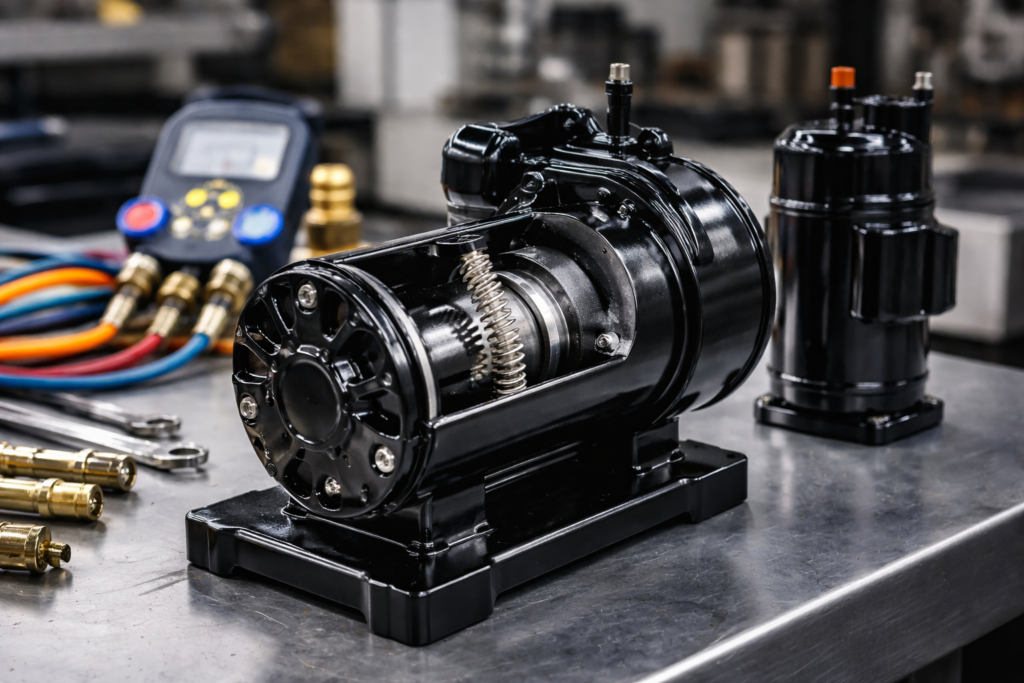
A rotary compressor is a type of positive displacement compressor that uses a rotating mechanism — typically a roller or vane — to compress refrigerant gas. Unlike reciprocating compressors that rely on a back-and-forth piston motion, rotary compressors compress gas through continuous rotational movement, which results in smoother operation, lower vibration, and quieter performance.
The term rotary compressor broadly refers to compressors where the gas compression happens due to the eccentric rotation of a roller inside a cylinder. This design is particularly well-suited for applications where space is limited and quiet, consistent cooling is required — making it the default choice for residential and light-commercial air conditioning systems globally.
In the HVAC industry, when technicians refer to a rotary compressor for air conditioner units, they usually mean the hermetically sealed rotary type used in split ACs, window ACs, and small refrigeration units.
Rotary Compressor Working Principle
The rotary compressor working principle is elegantly simple, yet mechanically precise. Here’s a step-by-step breakdown of how the process works:
- Low-pressure refrigerant gas enters the cylinder through the suction port from the evaporator side of the system.
- Inside the cylinder, an eccentric roller (mounted off-centre on a rotating shaft) moves in a circular path along the inner wall of the cylinder.
- As the roller rotates, it traps pockets of refrigerant gas between itself and the cylinder wall. A spring-loaded vane maintains contact with the roller, separating the suction and discharge zones.
- The rotating motion progressively reduces the volume of each gas pocket, compressing the refrigerant to a higher pressure and temperature.
- The compressed, high-pressure gas is discharged through the outlet valve into the condenser, where it releases heat before flowing to the expansion device and evaporator.
This cycle repeats continuously as long as the compressor runs. Because the motion is rotational rather than reciprocating, there are no abrupt direction changes, resulting in minimal vibration and a smooth, consistent compression cycle.
Most modern rotary compressors used in HVAC systems are hermetically sealed, meaning the motor and compression mechanism are enclosed in a single welded housing filled with refrigerant and lubricating oil.
Types of Rotary Compressors
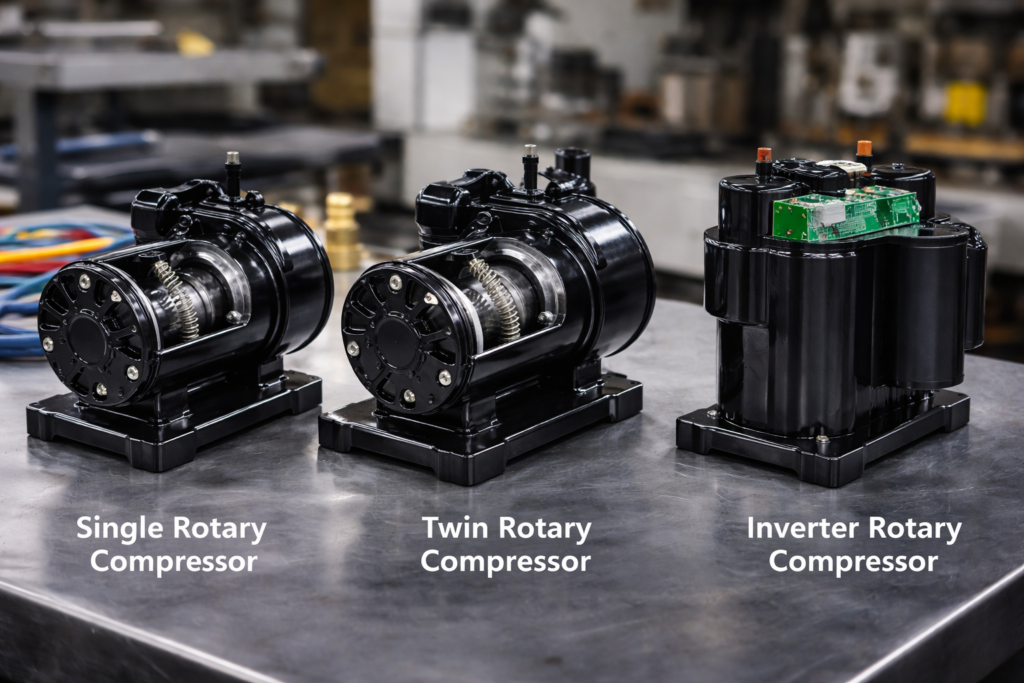
Not all rotary compressors are built the same. Depending on the application and system requirements, you’ll encounter three primary types:
1. Single Rotary Compressor
The most common type used in residential air conditioners. It features a single cylinder with one eccentric roller. Simple, cost-effective, and reliable — ideal for 1-ton to 2-ton split AC systems. The main limitation is slightly higher vibration compared to twin-cylinder models.
2. Twin Rotary Compressor
A twin rotary compressor uses two cylinders offset at 180 degrees, which significantly reduces vibration and pulsation. This design is preferred in larger residential and light-commercial units where quieter, more balanced operation is a priority. Twin rotary models are often found in 1.5-ton to 3-ton inverter ACs.
3. Inverter Rotary Compressor
Perhaps the most significant evolution in rotary compressor technology, inverter rotary compressors use variable-speed drives to modulate the compressor’s motor speed according to the cooling demand. Rather than switching the compressor on and off, an inverter rotary compressor runs at the precise speed needed — delivering dramatic improvements in energy efficiency (often 30–50% savings over fixed-speed models) and more consistent indoor temperatures.
Applications of Rotary Compressor in HVAC System
The rotary compressor in HVAC system appears across a surprisingly wide range of applications. The applications of rotary compressor span from simple home cooling to complex commercial refrigeration. Their compact footprint and smooth operation make them the go-to choice for the following:
Residential & Commercial Air Conditioners
The most dominant application. Virtually every split air conditioner sold in India today — from entry-level brands to premium inverter models — uses a hermetic rotary compressor for air conditioner cooling. Their ability to deliver efficient cooling in a compact form factor is unmatched for this purpose.
Refrigeration Systems
Small rotary compressor for refrigeration units are commonly used in light commercial refrigeration: display coolers, bottle coolers, under-counter refrigerators, and portable cooling units. Their low noise output is especially valued in retail and food service environments.
Cold Storage & Food Processing
For small to medium cold storage applications — walk-in coolers, flower storage rooms, and pharmaceutical cold rooms — rotary compressors offer an efficient solution, particularly when the required cooling capacity falls within the 1 TR to 5 TR range.
Supermarkets & Retail Chains
Multi-split and VRF (Variable Refrigerant Flow) systems used in large retail spaces often incorporate twin or inverter rotary compressors to manage multiple indoor units simultaneously with high energy efficiency.
Dehumidification Equipment
Industrial dehumidifiers used in warehouses, hospitals, libraries, and food storage facilities frequently use rotary compressors due to their reliable continuous operation and compact design.
Advantages of Rotary Compressors
The widespread adoption of rotary compressors across HVAC and refrigeration applications is no accident. Here are the core advantages that make them the preferred choice:
- Energy Efficiency: Inverter rotary compressors in particular offer exceptional energy performance, with ISEER ratings above 5 in top-tier models — significantly reducing electricity bills in long-run applications.
- Compact Size: The cylindrical hermetic design takes up minimal space, allowing manufacturers to produce slim, wall-mounted AC units and compact refrigeration cabinets.
- Low Vibration & Quiet Operation: Rotary motion inherently produces less vibration than reciprocating pistons. Twin-cylinder designs further minimize noise, making them ideal for bedrooms, hospitals, and hotels.
- Simple Construction: Fewer moving parts compared to scroll or reciprocating compressors means lower manufacturing costs and reduced likelihood of mechanical failure.
- Fast Startup: Rotary compressors reach operating speed almost instantly, which is an advantage in systems that cycle frequently.
- Wide Refrigerant Compatibility: Rotary compressors are compatible with common refrigerants including R-22 (legacy systems), R-410A, R-32, and R-134a, providing flexibility for system designers.
- Many HVAC contractors and system installers prefer sourcing equipment from a trusted rotary compressor supplier India to ensure reliability and consistent performance in cooling installations.
Rotary Compressor vs Scroll Compressor
Both rotary and scroll compressors are positive displacement, non-piston designs — but they differ significantly in construction, cost, and ideal applications. Here’s a side-by-side comparison:
| Feature | Rotary Compressor | Scroll Compressor |
| Working Mechanism | Rotating vanes/rollers | Orbiting spiral scrolls |
| Size & Weight | Compact and lightweight | Slightly larger |
| Noise Level | Low to moderate | Very low (quieter) |
| Energy Efficiency | High (especially inverter type) | Very high |
| Cooling Capacity | Small to medium (1–5 TR) | Medium to large (2–20 TR) |
| Cost | More affordable | Higher initial cost |
| Maintenance | Simple, fewer parts | Moderate complexity |
| Best For | Split ACs, small refrigeration | Commercial HVAC, VRF systems |
In summary: rotary compressors are the practical choice for smaller capacity systems where cost-efficiency and compact size matter most. Scroll compressors shine in larger commercial systems where maximum efficiency and ultra-quiet operation justify the higher investment.
Rotary Compressor Price in India – Factors That Affect Cost
If you’re sourcing a unit and want to understand rotary compressor price in India — whether for an OEM application, replacement, or a new system installation — understanding the factors that influence pricing will help you make an informed procurement decision.
- Brand & Manufacturing Quality: Premium brands (Daikin, Embraco, Tecumseh, Highly, Panasonic) command higher prices than budget alternatives. Build quality, warranty terms, and after-sales support all factor into the premium.
- Cooling Capacity (Tonnage): A small rotary compressor for refrigeration (0.5 TR to 1 TR) will naturally cost less than a 3 TR or 5 TR unit designed for heavier-duty commercial applications.
- Refrigerant Type: Compressors designed for newer refrigerants like R-32 or R-410A may carry a different price point than legacy R-22 units, partly due to design requirements for higher operating pressures.
- Fixed Speed vs. Inverter: Inverter-driven rotary compressors cost more upfront than fixed-speed models, but deliver lower operating costs over time — often making them more economical over a 3–5 year horizon.
- Application Rating: Compressors rated for low-temperature applications (like cold storage or freezer systems) require specialized components that increase their cost relative to standard air conditioning units.
For accurate pricing on specific models and capacities, you can request a quote directly from a verified rotary compressor supplier India. Prices can vary significantly by state, quantity, and procurement channel.
How to Choose the Right Rotary Compressor for Air Conditioner Systems
Selecting the correct rotary compressor for air conditioner or refrigeration application requires evaluating several technical and commercial parameters:
1. Define the Required Cooling Capacity
Match the compressor’s rated capacity (in BTU/hr or TR) to the heat load of the space being cooled. Undersizing causes inadequate cooling; oversizing leads to short-cycling and efficiency losses.
2. Choose the Right Refrigerant
Confirm which refrigerant your system is designed for — R-32, R-410A, R-134a, or R-22 — and select a compressor rated for that specific refrigerant. Mixing refrigerants or using incompatible compressors can cause system failure.
3. Fixed Speed or Inverter?
For applications with variable load (most residential and commercial AC installations), inverter rotary compressors offer better long-term economics. For constant-load refrigeration with stable temperature requirements, fixed-speed compressors may be more practical.
4. Consider the Operating Environment
High ambient temperature environments (above 50°C) require compressors rated for tropical conditions. Confirm the compressor’s maximum allowable operating temperature and discharge pressure before specifying it for an installation.
5. Source from a Reputable Supplier
Always procure compressors from an authorized distributor or verified rotary compressor supplier India. Counterfeit or substandard compressors are unfortunately common in the Indian market and can lead to frequent breakdowns and warranty disputes.
Frequently Asked Questions
Q1. What is a rotary compressor used for?
A rotary compressor is primarily used in air conditioning systems — particularly split ACs and window ACs — as well as in light commercial refrigeration, cold storage units, dehumidifiers, and heat pump systems. It compresses refrigerant gas as part of the vapor compression refrigeration cycle, enabling heat transfer from indoors to outdoors.
Q2. How does a rotary compressor work?
The rotary compressor working principle involves an eccentric roller that rotates inside a cylinder. As the roller turns, it traps refrigerant gas between itself and the cylinder wall, progressively compressing it to high pressure. A spring-loaded vane keeps the suction and discharge zones separated throughout the rotation cycle. The compressed gas is then discharged to the condenser.
Q3. Where is a rotary compressor used in HVAC systems?
The rotary compressor in HVAC system applications is most commonly found in residential and light-commercial split air conditioners, VRF (Variable Refrigerant Flow) systems, portable AC units, and heat pumps. They are the default compressor type for 1 TR to 5 TR cooling applications in the Indian HVAC market.
Q4. What refrigerant is used in rotary compressors?
Modern rotary compressors are designed to work with environmentally preferred refrigerants such as R-32, R-410A, and R-134a. Older systems may use R-22 (now being phased out under the Montreal Protocol). The choice of refrigerant depends on the system design, operating pressures, and applicable regulations.
Q5. What is the difference between a rotary compressor and a scroll compressor?
The key differences lie in the compression mechanism and application range. Rotary compressors use a roller and vane inside a cylinder and are best suited for smaller capacity systems (1–5 TR). Scroll compressors use two interleaved spiral scrolls to compress gas and are preferred for medium to large commercial systems. Scroll compressors are generally quieter and more efficient at higher capacities, but cost more than rotary units.
Conclusion
The rotary compressor remains one of the most important and widely deployed components in modern HVAC and refrigeration systems. From the humble window air conditioner to complex multi-split commercial installations, its combination of compact size, energy efficiency, low noise, and reliable performance makes it the first choice for engineers and system designers around the world.
Compressor Refrigeration Pvt Ltd proudly serves customers beyond India’s borders, exporting high-quality refrigeration and HVAC compressors to markets across the Middle East, Africa, Southeast Asia, and beyond. As a reliable rotary compressor export in India with years of export experience, we understand the importance of timely delivery, competitive pricing, and compliance with international quality standards. Our export clients include HVAC contractors, cold storage developers, and industrial refrigeration companies who trust us for consistent product quality and professional service. To discuss your export requirements, and contact our international sales team today.
Whether you’re specifying a new installation, replacing a failed unit, or evaluating compressor options for an OEM product, understanding the rotary compressor working principle, types, and applications of rotary compressor helps you make smarter, more cost-effective decisions.
For HVAC professionals and industrial buyers in India, Compressor Refrigeration Pvt Ltd is a trusted name in the refrigeration and HVAC compressor supply space. With a wide range of rotary, scroll, and reciprocating compressors from leading global brands, they serve contractors, OEMs, and service companies across the country.
A structured, technically capable export partner is not merely a supplier—but a long-term trade ally in sustaining industrial growth and operational reliability.