


Rotary compressor problems are among the most common challenges faced by HVAC technicians, refrigeration engineers, and AC repair professionals across India and the Gulf region. Whether you’re working with a Daikin split system in Dubai, a GMCC-powered unit in Riyadh, or an LG air conditioner in Delhi, compressor faults can disrupt performance, raise energy costs, and cause complete system failure. Understanding the root causes of these issues is essential for fast diagnosis, cost-effective repair, and long-term equipment reliability.
This guide covers the top 10 rotary compressor problems in detail — complete with causes, symptoms, and practical solutions. It is written for technicians, buyers, and HVAC professionals looking for actionable, expert-level rotary compressor troubleshooting guidance.
If you are looking for a reliable and energy-efficient solution for your HVAC or refrigeration system, explore our wide range of Rotary compressors designed for consistent performance and durability. At CompressorCR, we supply high-quality models from trusted brands like GMCC, LG, Toshiba, and Daikin, suitable for air conditioners, cold rooms, and commercial refrigeration applications. Whether you need a compact compressor for residential AC units or a heavy-duty option for industrial use, our collection ensures optimal cooling efficiency and long service life. Browse our complete range of rotary compressors to find the right model for your requirement.
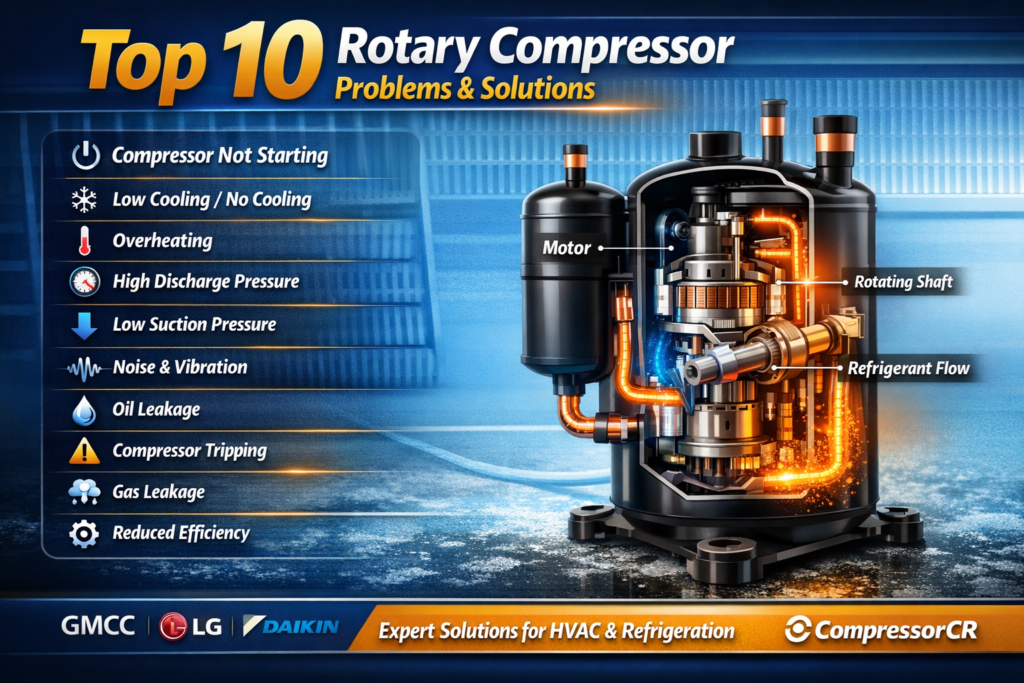
Problem 1: Compressor Not Starting
Causes: Faulty start capacitor, low supply voltage, open or shorted motor windings, tripped thermal overload protector, or a defective contactor relay.
Symptoms: The AC unit powers on but produces no cooling. The outdoor unit fan runs, but the compressor remains silent. The circuit breaker may trip repeatedly.
Solutions: Check and replace the start/run capacitor. Measure supply voltage — it should be within ±10% of rated voltage. Test motor windings with a multimeter. Reset the thermal overload and identify its root cause. Inspect and replace the contactor if burned or pitted. Brands like Toshiba and GMCC compressors include built-in protection modules — verify these are not latched in fault mode.
Problem 2: Low Cooling or No Cooling
Causes: Low refrigerant charge, a worn or damaged rotary vane, clogged expansion valve or filter-drier, or incorrect refrigerant type.
Symptoms: Room temperature does not drop despite the system running. The suction line feels warm rather than cold. Discharge temperature is higher than normal.
Solutions: Check refrigerant charge using manifold gauges. Inspect and replace the filter-drier and expansion valve. Confirm the correct refrigerant type (R-32, R-410A, or R-22) is being used. If the rotary vane shows wear, the HVAC compressor unit may need replacement — CompressorCR stocks direct replacements for GMCC, LG, and Daikin models.
Problem 3: Overheating
Causes: Insufficient lubrication due to low or degraded oil, high ambient temperature (common in Gulf countries like UAE and Qatar), dirty condenser coils, or excessive discharge pressure.
Symptoms: The compressor shell is extremely hot to the touch. The thermal overload trips frequently. Discharge gas temperature exceeds 120°C. The system short-cycles.
Solutions: Clean the condenser coils thoroughly. Verify refrigerant charge — both overcharge and undercharge cause overheating. Ensure adequate airflow around the outdoor unit. In high-ambient environments (above 45°C, as commonly seen in Saudi Arabia and Oman), ensure the compressor is rated for high-ambient operation. Replace compressor oil if contaminated.
Problem 4: High Discharge Pressure
Causes: Non-condensable gases (air or nitrogen) in the system, overcharged refrigerant, dirty or blocked condenser, or a malfunctioning condenser fan motor.
Symptoms: High head pressure reading on manifold gauges. Compressor running hot. Pressure relief valve activating. System may trip on high-pressure cutout.
Solutions: Purge non-condensables by recovering and recharging refrigerant correctly. Clean the condenser coils. Confirm the condenser fan motor is running at the correct speed. Check that the refrigerant charge matches the system’s nameplate specification. High discharge pressure in refrigeration compressors in hot climates is a critical issue — address it promptly to prevent compressor failure.
Problem 5: Low Suction Pressure
Causes: Refrigerant undercharge (leak), a restricted or blocked expansion device, a clogged filter-drier, or a faulty evaporator fan motor.
Symptoms: Suction line frost or ice buildup. Low suction pressure on gauges (below system design pressure). Reduced airflow from indoor unit. Compressor running continuously without achieving setpoint.
Solutions: Perform a leak test using a refrigerant detector or nitrogen pressure test. Replace the filter-drier. Check and clean or replace the expansion valve. Verify the evaporator fan is running and indoor coil is clean. Recharge refrigerant to the correct level after resolving the underlying issue.
Problem 6: Noise or Vibration
Causes: Loose mounting bolts, worn or damaged internal vanes, liquid slugging (liquid refrigerant or oil entering the compressor), foreign particles inside the compressor, or failing motor bearings.
Symptoms: Rattling, grinding, or knocking sounds from the outdoor unit. Excessive vibration felt on refrigerant lines or the compressor shell. Noise worsens on startup.
Solutions: Tighten all mounting bolts and anti-vibration mounts. Check for liquid slugging — ensure the expansion device is correctly set and the system is not overcharged. If internal vane damage is confirmed, replacement of the refrigeration compressor is typically more cost-effective than repair. Toshiba and Daikin compressors with scroll/rotary hybrid designs are known for quieter operation; consider upgrading.
Problem 7: Oil Leakage
Causes: Damaged or worn shaft seal, cracked compressor shell (from liquid slugging or physical impact), loose service valves, or excessive internal pressure.
Symptoms: Oil stains or wet patches visible around the compressor body or refrigerant lines. Oil-contaminated filter-drier. Gradual drop in system performance over time.
Solutions: Identify the leak source using a UV dye kit or soap bubbles. Replace the shaft seal or cracked shell component where possible. In most field situations, a leaking rotary compressor shell requires full unit replacement. Ensure the replacement unit is correctly matched — CompressorCR provides matching support by tonnage, refrigerant type, and brand (GMCC, LG, Toshiba, Daikin).
Problem 8: Compressor Tripping
Causes: Thermal overload triggered by overheating, high-pressure cutout activation, low-voltage supply, electrical short in motor windings, or a faulty PCB control board.
Symptoms: Compressor starts and shuts off after a few seconds or minutes. The outdoor unit LED flashes an error code. The system resets temporarily after cooling down.
Solutions: Read and document any error codes from the PCB. Measure supply voltage at the compressor terminals. Use a megohmmeter to check winding insulation resistance — a reading below 1 MΩ indicates motor damage. Test and replace the thermal overload or pressure switch as needed. If the control board is faulty, repair or replace it. Persistent tripping in LG and GMCC units may indicate refrigerant imbalance — check the charge.
Problem 9: Gas (Refrigerant) Leakage
Causes: Corrosion of copper lines (especially in coastal areas of UAE, Oman, and Qatar), improper flaring or brazing during installation, valve core failure, or mechanical vibration causing joint fatigue.
Symptoms: Gradual loss of cooling capacity over weeks or months. Ice formation on the suction line. Hissing sounds near line connections. Refrigerant detector alarm.
Solutions: Use an electronic refrigerant leak detector to pinpoint the leak location. Repair or replace the damaged pipe section or fitting. Re-braze connections using nitrogen purge to prevent oxidation. After repair, pressure-test with dry nitrogen to 400–500 PSI for at least 30 minutes before recharging. Gas leakage is both an environmental and safety concern — handle with care per local regulations in India and the Gulf.
Problem 10: Reduced Efficiency
Causes: General wear and tear of internal vanes, contaminated or degraded compressor oil, incorrect refrigerant charge (over or under), dirty heat exchangers, or operating beyond the compressor’s rated duty cycle.
Symptoms: Higher electricity bills without change in usage. Longer run times to reach setpoint temperature. COP (Coefficient of Performance) drop confirmed by performance testing.
Solutions: Replace compressor oil at manufacturer-recommended intervals. Clean both evaporator and condenser coils. Verify refrigerant charge accuracy using superheat/subcooling method. Evaluate whether the existing HVAC compressor is properly sized for the load — especially important in commercial refrigeration in high-ambient regions. If efficiency has dropped significantly, replacing with a new inverter-driven rotary compressor from Daikin or Toshiba can deliver significant energy savings.
How to Choose the Right Rotary Compressor
Selecting the correct compressor for your application is as important as troubleshooting faults. Consider the following factors:
- Cooling Capacity (Tonnage/BTU): Match the compressor capacity to the room size and heat load. Undersized units work harder and fail faster.
- Refrigerant Compatibility: Confirm the unit supports your target refrigerant — R-32, R-410A, or R-22. Mismatching refrigerants causes immediate damage.
- Voltage & Phase: Single-phase (220–240V) for residential; three-phase for commercial and industrial refrigeration systems.
- Ambient Temperature Rating: In the Gulf region (UAE, Saudi Arabia, Qatar, Oman), always choose compressors rated for high-ambient operation (up to 52°C or above).
- Brand & Reliability: Brands like GMCC (Midea Group), LG, Toshiba, and Daikin have proven track records in both Indian and Gulf HVAC markets. OEM-matched replacements ensure compatibility.
- Inverter vs. Fixed Speed: Inverter-driven rotary compressors offer 30–40% better energy efficiency and are ideal for high-usage applications in India and the Middle East.
- Warranty & After-Sales Support: Always purchase from an authorized distributor who can provide warranty support and technical assistance.
Why Choose CompressorCR for Rotary Compressors
CompressorCR is a trusted supplier of OEM-grade rotary compressors for the HVAC and refrigeration industry, serving technicians and businesses across India and Gulf countries including the UAE, Saudi Arabia, Qatar, and Oman.
Here is why professionals across the region rely on CompressorCR:
- Wide Range: Stock includes GMCC, LG, Toshiba, and Daikin rotary compressors across all capacities — from 0.75 ton to 5 ton.
- Technical Matching Support: Our team helps you identify the correct replacement by model number, refrigerant type, and application.
- Genuine & Tested Units: Every compressor is tested before dispatch. No refurbished units — only factory-fresh stock.
- Pan-India & Gulf Delivery: Fast dispatch to Delhi, Mumbai, Chennai, Dubai, Riyadh, Doha, and Muscat.
- Competitive Pricing: Direct sourcing means better pricing than local distributors — without compromising quality.
- After-Sales Support: Our technical team is available for AC compressor repair guidance and post-purchase assistance.
Whether you need a single replacement unit or bulk supply for a service company, CompressorCR is your reliable rotary compressor partner.
Frequently Asked Questions
1. What are the most common rotary compressor problems in AC units?
The most common issues include compressor not starting, low or no cooling, overheating, refrigerant leakage, and compressor tripping. Most of these result from electrical faults, refrigerant imbalance, or mechanical wear. Regular preventive maintenance — including coil cleaning, refrigerant checks, and oil inspection — can prevent the majority of these problems.
2. How do I know if my rotary compressor needs replacement?
If the compressor winding insulation resistance falls below 1 MΩ, internal vane damage is confirmed, the shell is cracked or leaking oil, or efficiency has dropped more than 20–25% despite correct maintenance, replacement is usually more economical than repair. Seek expert rotary compressor troubleshooting before deciding.
3. Which rotary compressor brands are best for high-ambient climates like UAE and Saudi Arabia?
Daikin and Toshiba are widely regarded as the best for high-ambient applications due to their robust engineering and wide operating temperature ranges. GMCC compressors (used in many Midea and Carrier units) also perform well and offer excellent value. Always confirm the unit’s ambient rating before purchase.
4. How can I prevent overheating in a rotary HVAC compressor?
Ensure clean condenser coils, adequate airflow around the outdoor unit, correct refrigerant charge, and a functioning condenser fan. In India and Gulf countries with extreme summer temperatures, consider adding shade structures over outdoor units, using high-ambient rated compressors, and scheduling quarterly maintenance checks.
5. What is the typical lifespan of a rotary compressor?
A well-maintained rotary compressor typically lasts 10–15 years. Factors like operating hours, refrigerant quality, oil condition, supply voltage stability, and ambient temperature all affect longevity. Units operating in coastal or dusty environments (common in Oman and Qatar) may require more frequent servicing to reach their full service life.
Conclusion
Understanding and addressing rotary compressor problems promptly is essential for maintaining efficient, reliable HVAC and refrigeration systems. From electrical faults and refrigerant leaks to overheating and reduced efficiency, each issue has identifiable causes and practical solutions. By applying the rotary compressor troubleshooting steps outlined in this guide, HVAC professionals in India and across Gulf countries can reduce downtime, extend equipment life, and deliver better service to their customers.
For HVAC professionals and industrial buyers in India, Compressor Refrigeration Pvt Ltd is a trusted name in the refrigeration and HVAC compressor supply space. With a wide range of rotary, scroll, and reciprocating compressors from leading global brands, they serve contractors, OEMs, and service companies across the country.
A structured, technically capable export partner is not merely a supplier—but a long-term trade ally in sustaining industrial growth and operational reliability.

