Refrigeration compressor problems are among the most costly and disruptive issues faced by cold storage facilities, HVAC systems,and industrial plants. Whether you operate a supermarket chain i Mumbai, a food processing unit in Riyadh, or a pharmaceutical warehouse in Dubai — understanding the root causes, early warning signs, and practical fixes for common compressor failures can save thousands in downtime and repairs. This guide covers the top 10 refrigeration compressor problems, written for business owners, HVAC technicians, and procurement buyers across India and the Gulf.
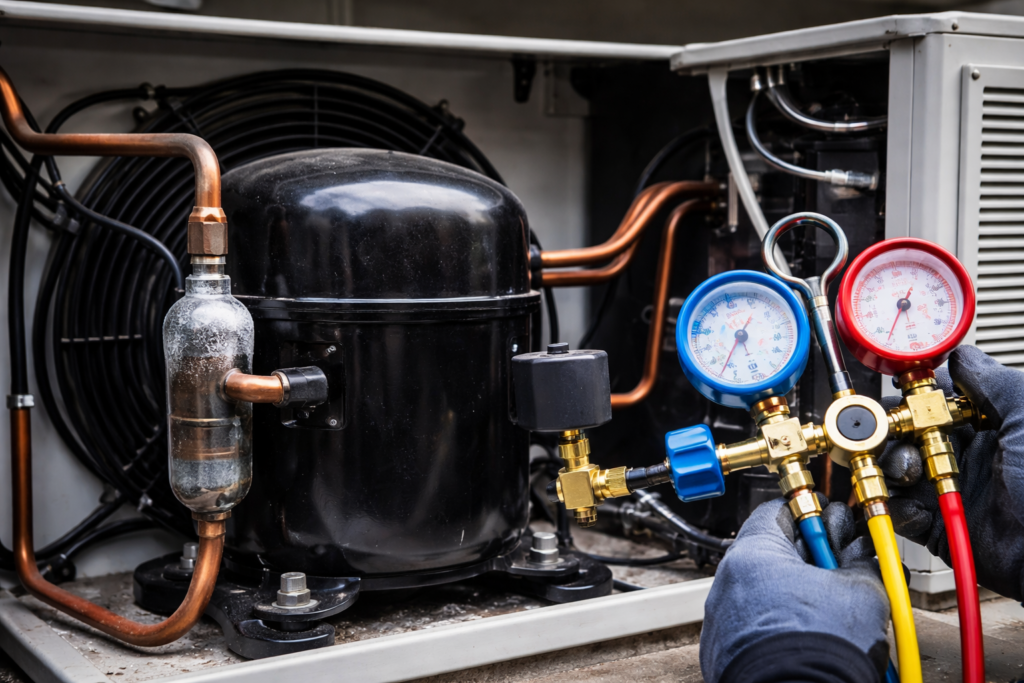
PROBLEM 1: COMPRESSOR NOT STARTING
CAUSES:
– Faulty capacitor or relay
– Low or no power supply
– Tripped thermal overload protector
– Seized compressor motor
– Defective thermostat signal
SYMPTOMS:
– Compressor hums but doesn’t run
– Breaker keeps tripping
– No response on startup
– Warm evaporator coil
SOLUTIONS:
– Test and replace the start capacitor
– Check supply voltage (±10% tolerance)
– Reset the overload protector
– Measure winding resistance — replace motor if open or shorted
PROBLEM 2: COMPRESSOR OVERHEATING
CAUSES:
– Inadequate refrigerant charge
– Dirty condenser coils
– Blocked airflow around the unit
– High ambient temperatures
– Worn internal components
SYMPTOMS:
– Discharge temperature exceeds 120°C
– Thermal cut-out trips repeatedly
– Oil turns dark or burns
– Compressor body too hot to touch
SOLUTIONS:
– Clean condenser fins and coils thoroughly
– Verify refrigerant charge level
– Ensure adequate ventilation clearance (minimum 300 mm)
– Install head cooling fans in high-ambient Gulf installations
[GULF CLIMATE TIP]
In UAE and Saudi Arabia, ambient temperatures can exceed 50°C. Always specify compressors rated for high-ambient operation (+55°C) when sourcing from an HVAC compressor supplier for UAE Saudi markets
PROBLEM 3: LOW COOLING OR NO COOLING
CAUSES:
– Refrigerant undercharge or overcharge
– Worn compressor valves
– Expansion valve malfunction
– Dirty evaporator coil
– High heat load in cold room
SYMPTOMS:
– Room temperature won’t reach setpoint
– Low pressure differential across compressor
– Long compressor run cycles
– Suction line not cold to touch
SOLUTIONS:
– Perform leak test and recharge refrigerant to correct level
– Replace defective discharge or suction valves
– Clean evaporator coil and check defrost cycle operation
– Review insulation integrity of the cold room
NOTE: For cold storage compressor problems in food or pharma applications, even a 2–3°C deviation can compromise product integrity — never delay diagnosis.
PROBLEM 4: HIGH DISCHARGE TEMPERATURE
CAUSES:
– Leaking or worn discharge valves
– Low suction superheat setting
– Incorrect refrigerant type used
– High compression ratio
SYMPTOMS:
– Discharge line is extremely hot to touch
– Oil carbonization and sludge buildup
– Refrigerant breakdown over time
SOLUTIONS:
– Inspect and replace discharge valves
– Adjust superheat settings on the TXV (thermostatic expansion valve)
– Verify correct refrigerant per OEM specification
– Reduce compression ratio by adjusting condenser conditions
PROBLEM 5: LOW SUCTION PRESSURE
CAUSES:
– Refrigerant leak in the system
– Restricted or blocked filter drier
– Low evaporator load
– TXV not opening fully
– Iced-up evaporator coil
SYMPTOMS:
– Low suction gauge reading
– Frost on suction line or compressor body
– Poor overall cooling performance
SOLUTIONS:
– Leak test the system and recharge refrigerant
– Replace filter drier if blocked or saturated
– Defrost evaporator coil manually
– Recalibrate or replace the TXV
PROBLEM 6: UNUSUAL NOISE OR VIBRATION
CAUSES:
– Liquid slugging (liquid refrigerant entering compressor)
– Loose mounting bolts or brackets
– Worn bearings or pistons
– Refrigerant overcharge
SYMPTOMS:
– Knocking, rattling, or squealing sounds during operation
– Visible vibration transmitted to pipework
– High amp draw accompanied by noise
SOLUTIONS:
– Install crankcase heater to prevent liquid slugging
– Tighten all mounting hardware
– Replace worn internal components (bearings, pistons, rods)
– Add vibration isolator pads under the compressor.
PROBLEM 7: COMPRESSOR SHORT CYCLING
CAUSES:
– System oversized for the actual load
– Faulty pressure controls
– Low refrigerant charge
– Thermostat differential set too narrow
SYMPTOMS:
– Compressor starts and stops rapidly (multiple times per hour)
– Poor energy efficiency and high bills
– Premature motor and electrical wear
– Temperature fluctuations in the refrigerated space
SOLUTIONS:
– Widen thermostat differential band
– Check and recalibrate pressure switches
– Verify system sizing against actual thermal load
– Recharge refrigerant to correct operating level
NOTE: Short cycling is one of the most common HVAC compressor issues in oversized cold storage installations across India —especially in newly constructed facilities.
PROBLEM 8: OIL RETURN PROBLEMS
CAUSES:
– Improper piping design creating oil traps
– Very low refrigerant velocity in suction lines
– Wrong oil viscosity for the application
– Oversized suction risers
SYMPTOMS:
– Low oil level visible in crankcase sight glass
– Bearing failure developing over time
– Foamy or milky oil appearance
– Oil visible in refrigerant lines
SOLUTIONS:
– Redesign suction risers using a double-riser arrangement
– Verify correct oil type per refrigerant (POE oil for HFC refrigerants)
– Install an oil separator and dedicated oil return lines
– Maintain minimum refrigerant velocity for oil entrainment
PROBLEM 9: REFRIGERANT LEAKAGE ISSUES
CAUSES:
– Corroded or cracked fittings and joints
– Vibration-induced joint fatigue and failure
– Improper flaring or brazing during installation
– Schrader valve leaks at service ports
SYMPTOMS:
– Gradual loss of cooling capacity over weeks
– Oil stains or residue near joints and fittings
– Positive result on electronic leak detector
– Hissing sound near valves or service ports
SOLUTIONS:
– Use nitrogen pressure test to locate all leaks
– Re-braze or replace faulty pipe joints
– Apply vibration isolation clamps on copper pipework
– Always use certified refrigerant per F-gas/BEE norms
[REGULATORY NOTE]
In India, refrigerant handling is regulated under the ODS Rules (Environment Protection Act). In the UAE and Qatar, comply with local ADSSC and Kahramaa environmental guidelines.
PROBLEM 10: ELECTRICAL FAULTS IN COMPRESSOR
CAUSES:
– Voltage imbalance between three phases
– Burnt motor windings from overload
– Ground fault or short circuit in motor
– Failed contactor or starting relay
– Power surge or lightning strike
SYMPTOMS:
– Compressor draws excessive current (overcurrent)
– Burnt smell coming from motor compartment
– MCB/MCCB trips repeatedly
– Megger test shows low insulation resistance (below 1 MΩ)
SOLUTIONS:
– Megger test all three motor windings (minimum 1 MΩ to ground)
– Check and balance 3-phase supply (max. 2% voltage imbalance)
– Replace contactor if contact surfaces are pitted or welded
– Install surge protection devices (SPD) on the electrical panel
PREVENTIVE MAINTENANCE TIPS FOR REFRIGERATION COMPRESSORS
Proactive maintenance is far more cost-effective than emergency repairs — especially for industrial refrigeration compressor systems running 24/7 in food processing, pharmaceuticals, or logistics.
1. MONTHLY CHECKS
Inspect oil level, check refrigerant pressures, clean condenser coils, verify all electrical connections are tight and corrosion-free.
2. TEMPERATURE & PRESSURE LOGGING
Log suction and discharge pressures and temperatures daily.Trending data reveals developing problems weeks before failure.
3. CRANKCASE HEATER OPERATION
Ensure crankcase heaters remain energized during off-cycles to prevent refrigerant migration into compressor oil.
4. MOISTURE CONTROL
Replace filter driers annually or after any system opening. Moisture is the single biggest enemy of long compressor life.
5. ELECTRICAL PANEL INSPECTION
Thermographically inspect electrical panels every 6 months to detect hot connections before they cause failures.
6. ANNUAL FULL SERVICE
Perform oil analysis, valve inspection, leak testing, and control calibration — preferably before the summer peak season in both India and the Gulf region.
Compressor Refrigeration Pvt Ltd is a leading refrigeration Compressor supplier in India and a recognised compressor exporter from India serving UAE, Saudi Arabia, Qatar, and Oman. Their range covers scroll, rotary, and reciprocating compressors — each tested to international standards. Contact their technical team at /contact
FREQUENTLY ASKED QUESTIONS
Q1. What are the most common signs of refrigeration compressor failure?
A: The most common signs include the compressor not starting,unusual knocking noises, warm air output despite the system running,high electricity bills due to short cycling, and visible oil stains or frost near fittings. Early detection through regular monitoring is key to avoiding costly breakdowns.
Q2. Why is my compressor running but not cooling properly?
A: A compressor that runs but doesn’t cool is typically caused by low refrigerant charge, worn-out valves that can’t build sufficient pressure, or a blocked expansion valve. A technician should check pressures and perform a valve efficiency test to diagnose the root cause accurately.
Q3. How do I prevent compressor overheating in high-ambient Gulf countries?
A: Specify compressors rated for high-ambient operation (up to 55°C), ensure clear ventilation around the condensing unit, keep condenser coils clean, and consider installing additional head cooling fans. Regular maintenance during spring before the summer peak is especially important in UAE, Saudi Arabia, and Qatar.
Q4. How often should refrigeration compressor oil be changed?
A: For most industrial refrigeration compressors, oil should be analysed annually and changed every 2–3 years per OEM guidance. After any burnout or moisture contamination, an immediate oil flush and filter drier replacement is mandatory to prevent acid damage.
Q5. Where can I source reliable refrigeration compressors for cold storage projects in India and the Gulf?
A: Compressor Refrigeration Pvt Ltd is a well-established refrigeration compressor supplier in India with an active export program to UAE, Saudi Arabia, Qatar, and Oman. They supply scroll,rotary, and semi-hermetic compressors suited for commercial and industrial refrigeration applications.
Conclusion
Understanding refrigeration compressor problems and their solutions is essential for maintaining efficient HVAC and cooling systems. From compressor not starting to refrigerant leakage, each issue requires proper diagnosis and timely action. Regular maintenance and choosing a trusted HVAC compressor supplier for UAE Saudi markets can significantly improve system performance and lifespan.
The key is a combination of trained technicians, systematic refrigeration compressor troubleshooting, and proactive preventive maintenance schedules. Partnering with a reliable refrigeration compressor supplier in India who understands both domestic and Gulf market requirements makes a significant operational difference.
For HVAC professionals and industrial buyers in India, Compressor Refrigeration Pvt Ltd is a trusted name in the refrigeration and HVAC compressor supply space. With a wide range of rotary, scroll, and reciprocating compressors from leading global brands, they serve contractors, OEMs, and service companies across the country.
A structured, technically capable export partner is not merely a supplier—but a long-term trade ally in sustaining industrial growth and operational reliability.