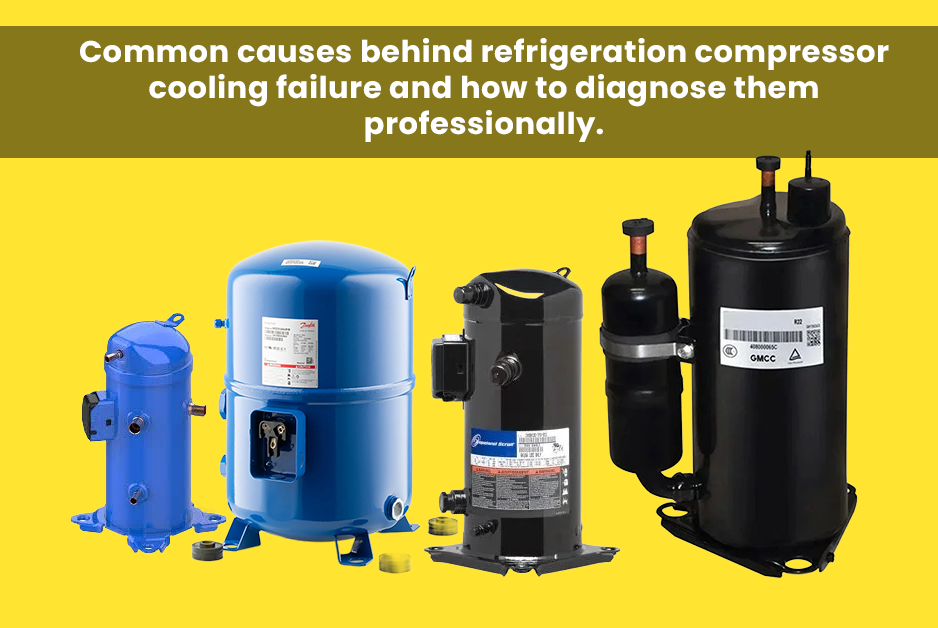
A refrigeration compressor that is running but not cooling is not simply an inconvenience — it is a business-critical failure. For cold storage operators in India, food processing plants, pharmaceutical warehouses, and commercial facilities across the Gulf region, every hour of compromised cooling translates directly into product loss, compliance risk, and operational downtime.
The challenge for maintenance teams and procurement engineers is that a compressor appearing to run normally at the electrical panel can mask a serious underlying problem. Discharge pressure may look acceptable. The motor may draw within spec. Yet the system refuses to pull temperature down. This guide breaks down the most common reasons a refrigeration compressor fails to cool effectively, with technically grounded solutions drawn from real-world industrial experience.
Whether you are managing a rack system for a supermarket chain, a screw compressor package for a cold storage facility, or a semi-hermetic reciprocating unit for a process cooling application, the diagnostic framework here applies.
1. Low Refrigerant Charge
What Is Happening
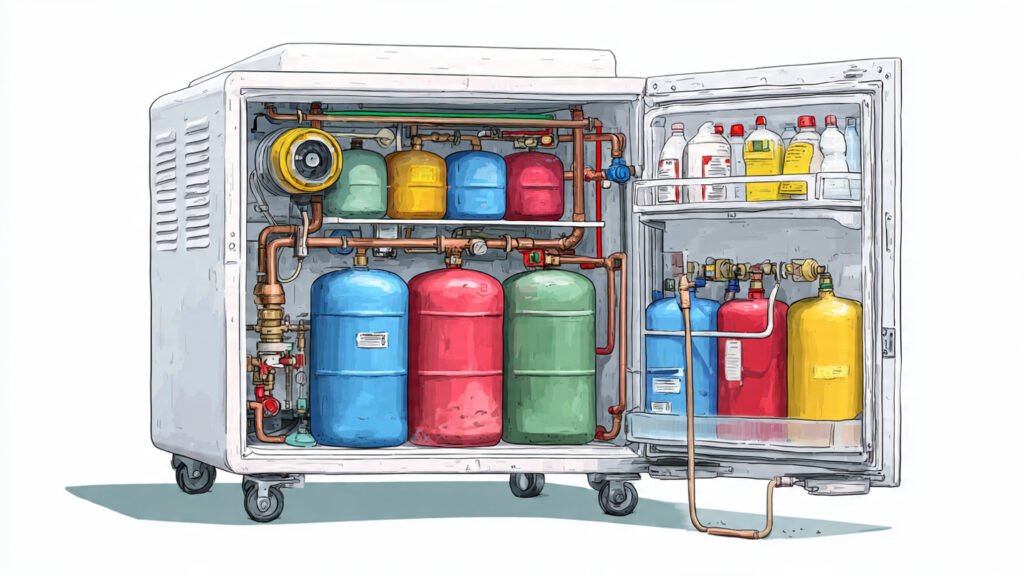
Refrigerant is the working fluid of any vapour compression system. When the charge falls below the system’s designed level — whether through a slow leak at a Schrader valve, a brazed joint failure, or improper servicing — the compressor loses its ability to absorb and transfer heat effectively. The suction pressure drops, the evaporator starves, and the cabinet or space temperature climbs despite the compressor running.
In India and the Gulf, systems operating at ambient temperatures of 40–50°C already push condensing pressures to their limits. A marginal refrigerant shortfall that might be tolerated in a temperate climate becomes a critical failure in a desert or tropical environment.
How to Identify It
- Low suction pressure on the gauge set (below manufacturer specification for operating conditions)
- Frost or ice forming on the suction line closer to the compressor than expected
- Compressor running long cycles without reaching set-point temperature
- Bubbles visible in the liquid line sight glass
Professional Solution
Do not simply top up the refrigerant. First, conduct a proper leak detection procedure — nitrogen pressure test, electronic leak detector, or UV dye trace depending on the refrigerant type and system access. Identify and repair all leak points before recharging to the manufacturer-specified weight. Verify subcooling and superheat values post-charge to confirm correct fill level.
For More Information About Refrigeration Compressor Maintenance Guide Read More
2. Blocked or Fouled Condenser Coils
What Is Happening
The condenser is where the refrigeration system rejects heat absorbed from the refrigerated space. When the condenser coil surface becomes coated with dust, grease, lint, or biological growth, the heat transfer efficiency drops sharply. Head pressure rises, the compression ratio increases beyond design limits, and the compressor begins operating outside its safe envelope.
Poor cooling performance in commercial refrigeration compressor systems often stems from a highly underestimated factor: condenser coil contamination. In industrial facilities across India — especially within the food processing, textile, and pharmaceutical sectors — high ambient dust levels accumulate rapidly on condenser surfaces. Without a structured preventive maintenance schedule, this buildup can reduce heat dissipation efficiency within weeks rather than months, leading to higher discharge pressure, increased energy consumption, and compromised cooling output.
How to Identify It
- High head pressure or discharge temperature readings
- Compressor cycling on high-pressure cut-out
- Visibly dirty coil surface or restricted airflow around condenser section
- Increased power draw at the compressor motor
Professional Solution
Clean condenser coils with approved foaming coil cleaner and a low-pressure water rinse, always working in the reverse direction of normal airflow. For evaporative condensers in industrial installations, check water distribution nozzles and drift eliminators alongside the coil surface. Establish a scheduled cleaning frequency — typically every three to six months for high-dust environments, and monthly in coastal Gulf installations where salt fouling is a factor.
3. Damaged or Worn Compressor Valves
What Is Happening
The suction and discharge valves in a reciprocating compressor are precision components that control the flow of refrigerant vapour through the compression cycle. When these valves crack, warp, or lose their seating — through mechanical wear, liquid slugging, or thermal stress — the compressor loses compression efficiency. Gas bypasses back across the valves rather than being pumped forward, and cooling capacity drops significantly.
Valve damage is a leading cause of a compressor running but not cooling in older reciprocating units and in systems that have experienced liquid return events, which can happen when refrigerant overcharge or evaporator icing forces liquid into the suction line.
How to Identify It
- Low compression ratio despite correct refrigerant charge
- High suction and lower-than-normal discharge pressures simultaneously
- Unusual noise from the cylinder head — particularly a fluttering or ticking sound
- Elevated discharge temperature from gas re-compression
Professional Solution
Cylinder head removal and valve inspection is required. Valve plate assemblies should be replaced rather than refurbished in commercial applications where downtime cost is significant. When ordering valve assemblies, always specify the exact compressor model and serial number to ensure correct valve geometry and spring tension. Post-repair, run a compression test before returning the unit to full duty.
4. Electrical Supply Instability
What Is Happening
Compressor motors are sensitive to power quality. Voltage fluctuation, phase imbalance, and low voltage supply — all of which are documented challenges across industrial zones in India — cause motor windings to draw excessive current, generate additional heat, and operate outside their design torque curves. The practical result is a compressor that runs intermittently, fails to start reliably under load, or trips repeatedly on the motor overload relay.
Across Gulf countries, while grid quality is generally more stable, voltage variation during peak summer demand periods — when cooling loads are highest — can still affect compressor performance in facilities without proper power conditioning.
How to Identify It
- Frequent motor overload trips or thermal protection activation
- Motor running hot to the touch or elevated winding temperature readings
- Phase voltage imbalance greater than 2% on a three-phase supply
- Hard starting or failure to start under load
Professional Solution
Install a dedicated voltage stabiliser or automatic voltage regulator (AVR) sized for the compressor motor’s locked rotor amperage (LRA). Verify phase balance at the supply terminals and at the compressor motor terminals independently — a balanced supply at the panel can show significant imbalance at the equipment level if cabling is undersized. Replace burnt or degraded motor run capacitors on single-phase units. Where power quality is chronically poor, consider compressors with built-in soft starters or inverter-driven options.
5. Lubrication and Oil System Problems
What Is Happening
Refrigeration compressor oil serves multiple functions: it lubricates bearing and cylinder surfaces, seals clearances in the compression chamber, and removes heat from friction points. When oil becomes diluted with refrigerant, contaminated with moisture or acid, or depleted through excessive migration to the refrigerant circuit, lubrication breaks down. Component wear accelerates, discharge temperatures rise, and cooling performance degrades progressively.
Oil contamination is particularly relevant in older systems that have had refrigerant retrofits, or in systems operating with moisture ingress — a risk in poorly maintained systems in humid coastal environments.
How to Identify It
- Elevated discharge temperature without a corresponding increase in condensing pressure
- Low oil level in the sight glass after ruling out other causes
- Acid test indicating oil degradation (brown or dark oil, acrid smell)
- Bearing noise or increased vibration signature
Professional Solution
Perform an oil acid test and moisture content check. If contamination is confirmed, flush the system with a suitable flushing agent, replace the oil charge with the manufacturer-specified viscosity grade and refrigerant compatibility, and install a new filter drier in the liquid line. For large industrial screw compressors, oil analysis should be part of a scheduled maintenance programme.
→ [Internal Link: How to Select the Right Refrigeration Compressor for Your Application]
6. Incorrect Compressor Sizing
What Is Happening
An undersized compressor cannot handle the actual heat load of the refrigerated space. It runs continuously at full capacity yet fails to reach the required setpoint temperature. This issue occurs more often than expected. It typically appears when system loads increase after installation, when condenser capacity does not match ambient conditions, or when buyers select a replacement unit based on cost instead of accurate capacity calculation
In India and Gulf export markets, ambient temperatures can significantly exceed the design assumptions made for equipment originally rated in European or North American conditions. A compressor specified for 35°C ambient delivering rated capacity may fall well short of requirements at 46°C ambient in Rajasthan or Saudi Arabia.
Professional Solution
Conduct a proper heat load calculation for the space, accounting for current product load, ambient conditions, and infiltration. Compare this against the compressor’s capacity envelope at actual operating saturated suction temperature (SST) and saturated discharge temperature (SDT). If the unit is confirmed undersized, replacement with a correctly specified compressor is the only durable solution.
Cause vs. Solution: Quick Reference
| Root Cause | Symptoms | Recommended Action |
| Low Refrigerant | Poor cooling, hissing sounds, high discharge pressure | Leak test, re-charge, seal repair |
| Dirty Condenser Coil | Compressor overheating, high head pressure | Clean coils every 3–6 months |
| Faulty Valves | Weak cooling at rated load, loss of compression | Replace suction/discharge valve assemblies |
| Electrical Instability | Erratic cycling, motor overload trips, burnout | Install voltage stabiliser, check capacitors |
| Oil Contamination | Elevated discharge temperatures, bearing noise | Flush system, replace oil charge |
| Incorrect Sizing | Continuous max-load run, cannot reach setpoint | Replace with correctly sized compressor |
Repair vs. Replace: Making the Right Commercial Decision
Not every compressor fault justifies replacement, but not every fault justifies repair either. The decision framework for commercial and industrial operators should consider three factors: the age of the unit relative to its rated service life, the cost of the repair relative to replacement value, and the criticality of the application.
As a general industry guideline, if a repair costs more than 50% of a new compressor’s price and the unit is more than 60% through its service life, replacement is typically the better investment. For mission-critical applications — pharmaceutical cold rooms, blast freezers, process cooling — the cost of a second failure during peak operation will usually exceed the replacement cost many times over.
Compressors with burnt motor windings, cracked cylinder blocks, or severely scored bearings are almost always better replaced than rebuilt in commercial service. Valve replacements, capacitor changes, and refrigerant recharges on mechanically sound compressors, however, are typically cost-effective repairs.
Why Professional Diagnosis Matters
Field experience shows that misdiagnosis of compressor cooling problems is common — and expensive. A system re-charged with refrigerant when the real problem is a failed valve will simply lose refrigerant through the high-side relief or continue to perform poorly. A compressor replaced when a condenser cleaning would have restored performance represents unnecessary capital expenditure.
Authoritative diagnosis requires a full system approach: gauge manifold readings, temperature measurements at suction, discharge, liquid line, and evaporator outlet, electrical supply verification, and visual inspection of both the compressor and the heat exchanger surfaces. Attempting to diagnose a compressor fault at the component level in isolation, without understanding the system context, is the most common source of incorrect remediation.
For industrial operations with multiple compressor installations, a structured preventive maintenance programme — with documented baseline readings for each unit — transforms troubleshooting from reactive guesswork into data-driven decision making.
Looking for reliable equipment? Explore our Commercial & Industrial Refrigeration Compressor Product Range.
Frequently Asked Questions
Why is my refrigeration compressor running but not cooling the space down?
The most common reasons are low refrigerant charge, a dirty condenser coil reducing heat rejection, or worn internal valves that have lost compression efficiency.
Can voltage fluctuation cause a compressor to stop cooling?
Yes. Voltage instability causes motor stress and erratic cycling, which prevents the compressor from maintaining the continuous operation needed to pull system temperatures down.
How often should condenser coils be cleaned to prevent cooling problems?
In most commercial refrigeration applications, condenser coils should be inspected every three months and cleaned every three to six months.
When does a refrigeration compressor need to be replaced rather than repaired?
Replacement is generally recommended when repair costs exceed 50% of the replacement value on a unit that is more than halfway through its service life, when the compressor has suffered motor burnout or mechanical seizure, or when the unit is no longer sized correctly for the current load.
Is it normal for a new compressor to not cool properly immediately after installation?
A correctly installed and commissioned compressor should achieve near-design performance within the first operating hours. If a new unit is not cooling adequately, check for refrigerant charge accuracy, confirm the system has been properly evacuated before charging, verify condenser airflow is not restricted, and ensure the electrical supply meets the motor’s specifications.
Need Technical Guidance on Compressor Selection or Supply?
If your operation is experiencing persistent compressor cooling problems, the fastest path to resolution is a conversation with engineers who understand both the equipment and the operating environment. Whether you need a single replacement unit or bulk supply for a multi-site installation, getting the specification right from the outset saves significantly more than the cost of the compressor itself.
For industrial and commercial operations requiring dependable refrigeration compressor supply, Compressor Refrigeration Pvt. Ltd. offers technical procurement support backed by substantial inventory depth and established logistics for both domestic India supply and export to Gulf countries including UAE, Saudi Arabia, Oman, Kuwait, Bahrain, and Qatar. The company works directly with OEM-grade compressor brands across reciprocating, scroll, and screw compressor technologies, supporting projects across cold storage, food processing, pharmaceutical, and HVAC applications. For specifications, bulk availability, or export enquiries, visit or reach out to their technical team directly.