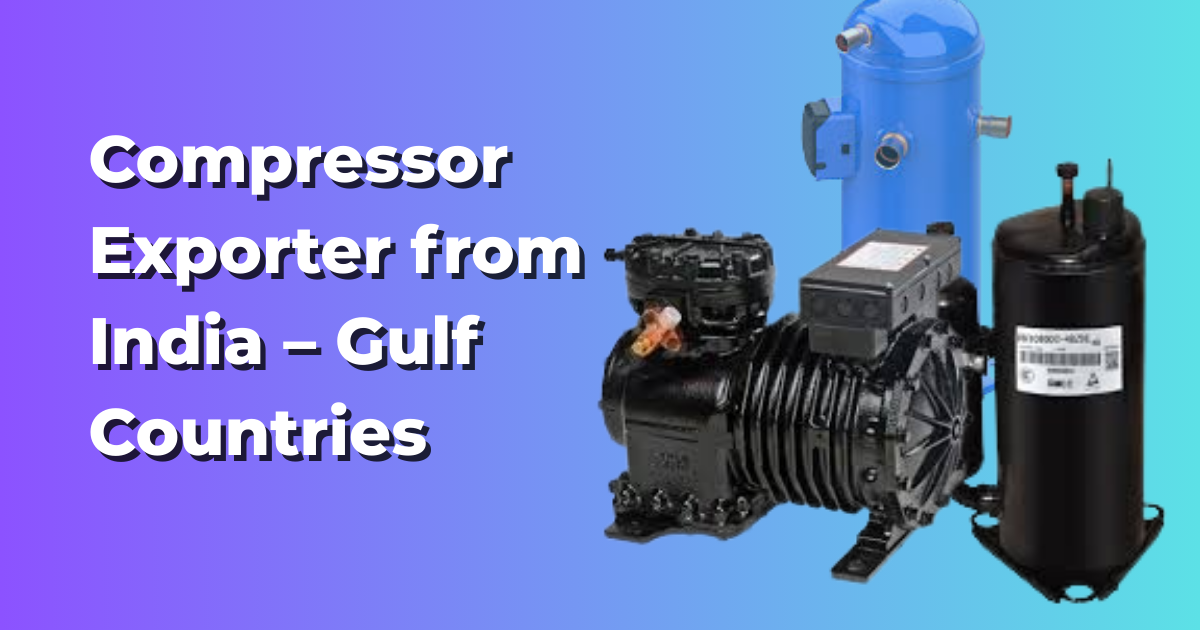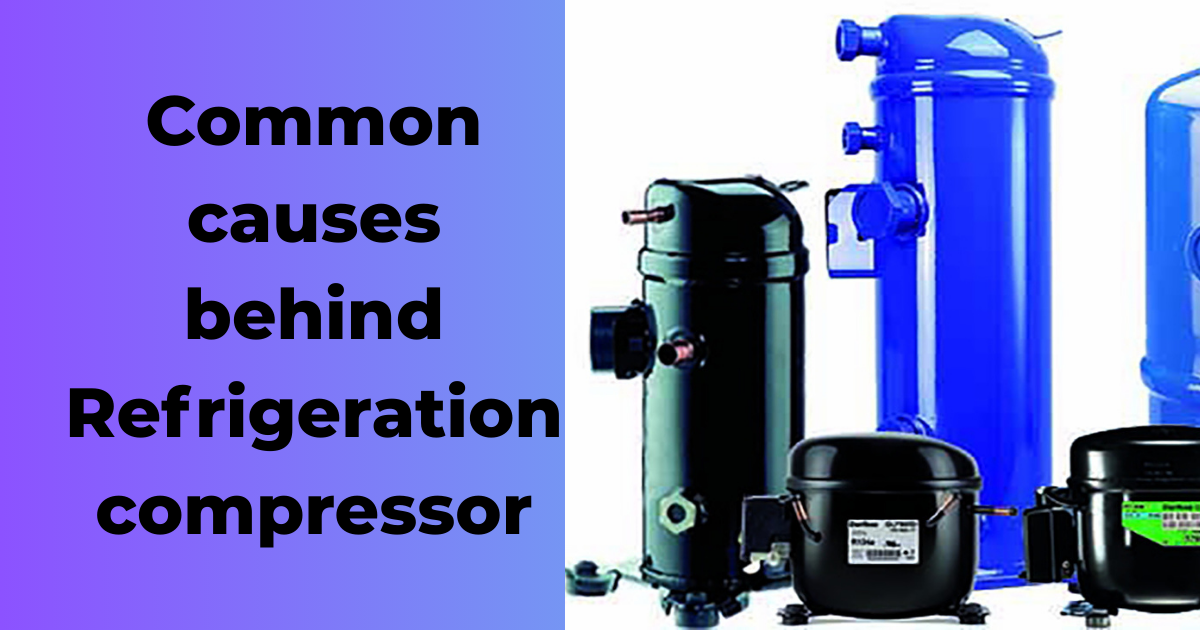

The Gulf Cooperation Council (GCC) region — including the Gulf Cooperation Council member states — operates some of the world’s most demanding industrial and HVAC environments. Sustained ambient temperatures exceeding 45°C, rapid infrastructure expansion, district cooling projects, and a strong MEP contracting ecosystem have created continuous demand for high-performance compressors capable of reliable operation under extreme climatic stress.
For procurement managers, project contractors, and distributors, the decision to import compressors from India is increasingly strategic rather than purely cost-driven. India has positioned itself as a dependable sourcing destination by combining competitive manufacturing economics with technical compliance and structured export systems.
As a trusted Compressor Exporter from India , suppliers today provide a wide spectrum of solutions — from hermetic refrigeration compressors to industrial screw and reciprocating air compressors — engineered for high-ambient operation. Many manufacturers align with international benchmarks such as ASHRAE, AHRI, ISO, and CE standards, ensuring suitability for commercial and industrial deployments across the Gulf region.
Beyond pricing advantages, Indian exporters bring decades of regional trade experience. They understand voltage configurations (220V/380V – 50Hz), tropicalized compressor variants, refrigerant compatibility for high condensing temperatures, and customs documentation requirements for GCC ports.
This guide explains the complete process of importing compressors from India — covering product selection, quotation procedures, Incoterms, documentation, logistics, and supplier evaluation — helping Gulf buyers reduce procurement risks and improve supply chain efficiency.
Step-by-Step Import Process for Compressors from India
Step 1: Define Product Requirements and Technical Specifications
Before contacting an exporter, buyers must prepare a comprehensive technical specification sheet. This should clearly define:
- Compressor type (reciprocating, scroll, screw, centrifugal)
- Refrigerant compatibility (R410A, R134a, R407C, R404A, R717, etc.)
- Capacity (TR or kW)
- Operating voltage and frequency
- Application (HVAC, refrigeration, industrial process)
- Required certifications
For Gulf installations, high-ambient capability (46°C–52°C) is critical. Compressors not rated for these conditions may suffer capacity reduction and premature failure.
Leading global brands frequently exported from India include:
- Copeland
- Danfoss
- Bitzer
- GMCC
Selecting the correct configuration at this stage prevents costly post-delivery adjustments.
Step 2: Request Formal Quotations
Once specifications are finalized, buyers should issue a structured RFQ to shortlisted suppliers. The RFQ should include:
- Model specifications
- Quantity
- Destination port
- Preferred Incoterms (FOB or CIF)
- Required delivery timeline
- Payment terms
Reputable exporters will provide itemized quotations with model numbers, lead times, certifications, and pricing clarity. Compare quotations based on total landed cost, not unit price alone.
For structured export coordination, buyers may submit inquiries via the Compressor Export Orders o receive formal documentation support and consolidated pricing.
Step 3: Confirm Technical Details & Issue Purchase Order
After supplier selection, issue a Purchase Order reconfirming:
- Model numbers
- Voltage and frequency
- Refrigerant compatibility
- Quantity
- Packaging standards
- Incoterms
- Delivery schedule
Explicitly stating Incoterms in the PO avoids future freight or liability disputes.
Step 4: Choose Between FOB and CIF Pricing
Understanding Incoterms is essential for cost and risk management.
FOB (Free on Board) import Compressors from India
Under FOB terms:
- Seller delivers goods onto the vessel at Indian port.
- Buyer handles freight, insurance, and destination costs.
Buyers frequently request Compressor FOB Price India to maintain control over freight contracts and consolidate shipments. import Compressors from India
CIF (Cost, Insurance, Freight)
Under CIF:
- Seller arranges freight and insurance to destination port.
- Risk transfers once goods reach the destination port.
CIF simplifies procurement for first-time importers but offers less freight negotiation control.
Step 5: Agree on Payment Terms
Common payment structures include:
- 30% advance, balance against documents (T/T)
- Confirmed Letter of Credit (LC)
- Deferred LC for repeat buyers
High-value industrial compressor export orders typically use LC for transaction security.
Step 6: Production & Pre-Shipment Inspection
Production lead times vary between 2–6 weeks depending on model availability and order volume.
For large projects, third-party inspection agencies such as SGS or Bureau Veritas may conduct pre-shipment inspection to verify quantity and specifications. import Compressors from India
Step 7: Shipment & Container Loading
Compressors are shipped via:
- 20ft or 40ft FCL containers for bulk orders
- LCL shipments for smaller quantities
Export packaging includes:
- Wooden crates
- Fumigated pallets
- Moisture-resistant wrapping
- Shock protection
Sea freight transit from India to major GCC ports typically ranges 8–12 days.
Step 8: Customs Clearance at Destination
Upon arrival at ports such as:
- Jebel Ali Port
- King Abdulaziz Port Dammam
- Hamad Port
Buyers must submit the complete document set for clearance.
Import duties vary depending on HS classification and national regulations.
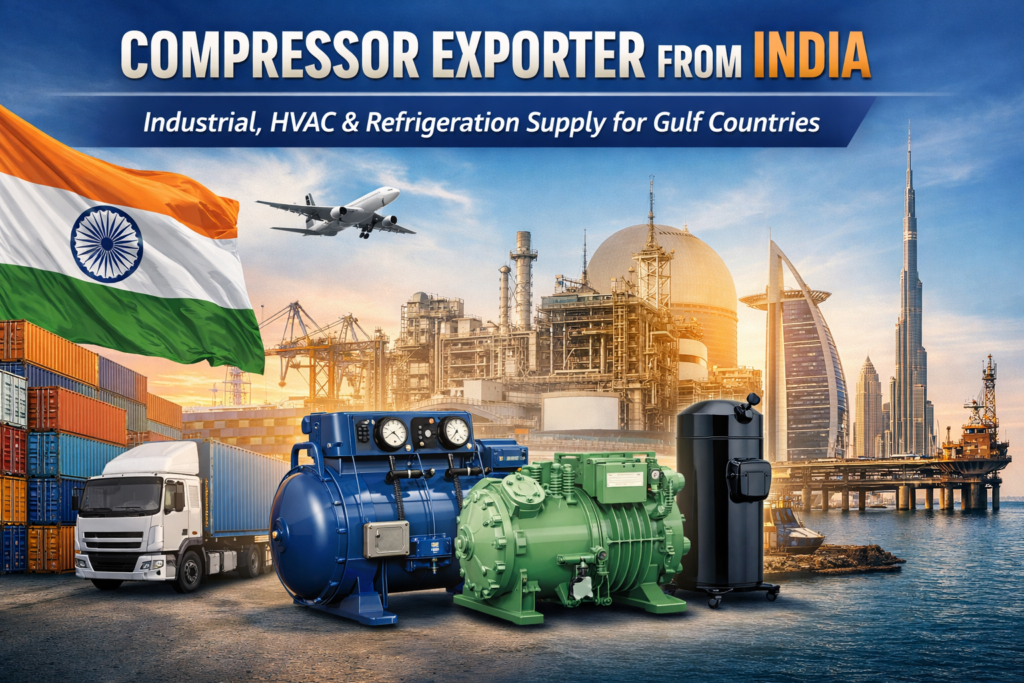
For a deeper understanding of India’s role in global compressor trade, technical capabilities, and bulk supply advantages, explore our detailed guide on Compressor Exporter from India – Industrial, HVAC & Refrigeration Supply for Gulf Countries. The pillar article explains compressor categories, FOB pricing structure, export documentation, packaging standards, and high-ambient suitability in detail, helping Gulf importers and project contractors make informed procurement decisions before requesting a quotation.
Required Export & Import Documents
Professional exporters provide a complete documentation package including:
Commercial Invoice – Includes HS code, product description, unit price, Incoterms.
Packing List – Lists carton details, weight, and dimensions.
Certificate of Origin – Confirms Indian manufacturing origin.
Bill of Lading – Title document issued by shipping line.
Marine Insurance Certificate (for CIF shipments).
Documentation accuracy directly impacts customs clearance speed.
Evaluating a Reliable Compressor Exporter from India
Selecting the right supplier reduces operational risk.
1. Gulf Market Experience import Compressors from India
Exporters familiar with high-ambient performance requirements reduce technical errors.
2. Bulk Capacity import Compressors from India
For distributors and contractors, bulk compressor shipment capability is essential.
3. Technical Expertise
Supplier teams should competently discuss refrigerants, motor insulation class, discharge pressure ratings, and ambient performance.
4. Brand Availability
Availability of globally trusted brands such as Copeland, Danfoss, Bitzer, and GMCC enhances project credibility.
5. Documentation Accuracy
Professional documentation ensures seamless customs and banking compliance.
Common Mistakes to Avoid
Incorrect Voltage Specification
GCC electrical standards vary. Confirm motor winding compatibility before order confirmation.
Wrong Refrigerant Selection
R22 vs R410A mismatch creates system incompatibility.
Underestimating Ambient Conditions
Standard 35°C-rated compressors are unsuitable for Gulf summers.
Ignoring Lead Times
Combined production and shipping time may extend to 6–10 weeks.
Not Clarifying Incoterms
Always specify FOB or CIF in Purchase Order and Invoice.
Frequently Asked Questions
How long does it take to import compressors from India?
Typically weeks including production, shipping, and clearance.
What is the minimum order quantity?
Many exporters accept small LCL orders, while bulk pricing improves at container level.
Can I mix models in one container?
Yes. Mixed model shipments are common for distributors.
Are compressors suitable for high temperatures?
High-ambient models rated up to 52°C are available when specified correctly.
What payment methods are accepted?
T/T, LC at sight, deferred LC, and documentary collections.
Is after-sales support available?
Established exporters provide warranty documentation, spare parts supply, and technical guidance.
Conclusion
Importing compressors from India offers Gulf buyers a balanced combination of technical reliability, competitive pricing, and structured export support. Success depends on accurate specification, choosing an experienced Compressor Exporter from India, and ensuring documentation compliance.
For structured procurement, bulk shipment planning, and competitive FOB pricing, visit our Compressor Export to request a tailored quotation.
A structured, technically capable export partner is not merely a supplier—but a long-term trade ally in sustaining industrial growth and operational reliability.