

What Are the Most Effective Methods for Preventing Compressor Breakdowns?
Introduction
In the world of HVAC, cold storage, and industrial refrigeration, the compressor is the beating heart of the system. When a compressor breaks down unexpectedly, the consequences are rarely limited to a simple repair bill. Cold storage operators face spoiled inventory. HVAC contractors deal with dissatisfied clients and system downtime. Industrial facilities lose production hours and revenue — sometimes running into lakhs of rupees in losses within a single day. prevent compressor breakdowns
Compressor failures are rarely sudden. In most cases, they are the end result of overlooked warning signs, deferred maintenance, or incorrect system operation. The good news is that the vast majority of compressor breakdowns are entirely preventable — provided that facility managers, maintenance teams, and HVAC professionals take a structured, proactive approach to compressor care.
This article outlines the most effective methods for preventing compressor breakdowns, helping you protect your investment, extend equipment life, and ensure uninterrupted system performance across HVAC plants, cold chain facilities, and industrial refrigeration installations.
Common Causes of Compressor Failures
Understanding why compressors fail is the first step toward preventing those failures. Industry experience across refrigeration and HVAC environments points to five primary root causes:
1. Overheating prevent compressor breakdown
Overheating is one of the most frequent causes of compressor damage. When discharge temperatures rise beyond design limits — often due to blocked condenser coils, poor airflow, or high ambient temperatures — internal components including valves, pistons, and motor windings suffer accelerated wear and permanent damage.
2. Electrical Issues
Voltage fluctuations, phase imbalances, single-phasing, and inadequate wiring are responsible for a significant share of compressor motor failures. Electrical problems create heat within the motor windings, degrade insulation, and can cause catastrophic burnout — especially in scroll and reciprocating compressor designs operating at high load. prevent compressor breakdowns
3. Lubrication Failure
Oil is critical to compressor longevity. Insufficient oil charge, oil contamination with moisture or refrigerant, and degraded oil viscosity cause metal-to-metal contact in bearings, pistons, and connecting rods. The resulting wear quickly leads to seized compressors and irreversible internal damage.
4. Refrigerant Problems
Both refrigerant undercharge and overcharge create stress on the compressor. Low refrigerant causes the suction pressure to drop, reducing the cooling effect on the compressor motor and leading to overheating. Overcharge causes liquid refrigerant slugging — where liquid rather than gas enters the compression chamber — which can crack valves and damage pistons instantly.
5. Contamination
Moisture, non-condensables (air), acid, and particulate debris inside the refrigerant circuit are silent compressor killers. Moisture combines with refrigerant to form corrosive acid that attacks copper windings, bearings, and valve seats. Particulate contamination — often introduced during poor service practices — scores cylinder walls and accelerates wear.
A professional Compressor Exporter from India offers not just competitive pricing, but structured documentation, bulk supply capability, technical expertise, and reliable logistics tailored to high-temperature operating environments.
Most Effective Methods to Prevent Compressor Breakdowns
Preventing compressor failures requires a combination of disciplined maintenance routines, proper system monitoring, and the use of protective equipment. Here are the most proven and effective methods used by leading HVAC contractors and cold storage operators:
1. Regular Preventive Maintenance
A structured preventive maintenance (PM) schedule is the single most impactful step any facility can take. This includes routine inspection of all mechanical and electrical components, filter cleaning or replacement, belt tension checks (where applicable), and a thorough system performance evaluation. PM schedules should be tailored to the operating hours and environment of each compressor — high-duty systems in cold storage may require monthly inspections, while lighter HVAC applications may be adequately covered by quarterly service visits.
2. Proper Refrigerant Charge Monitoring
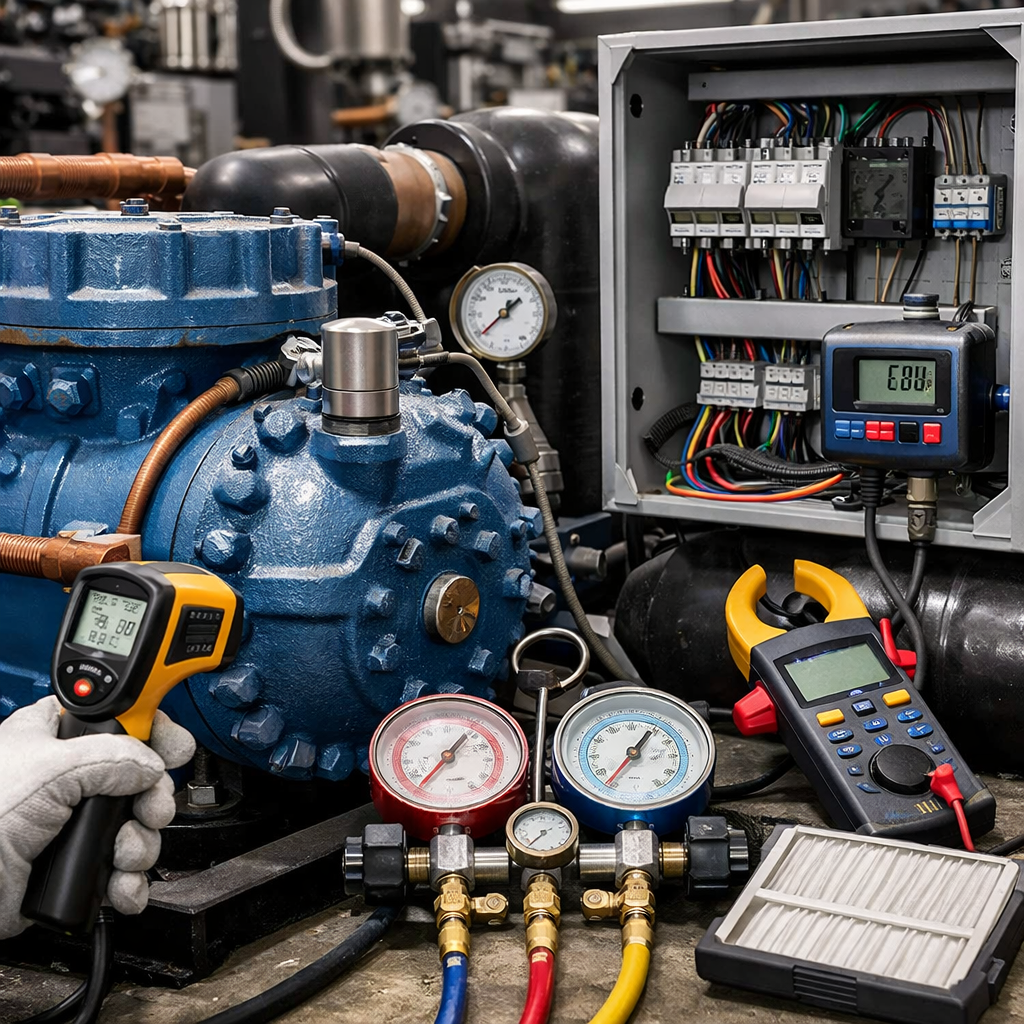
Maintaining the correct refrigerant charge is non-negotiable. Technicians should routinely measure suction and discharge pressures and compare them against manufacturer specifications and current operating conditions. Subcooling and superheat values provide accurate indicators of system charge status. Any refrigerant leaks should be repaired immediately — not topped up temporarily — to maintain the integrity of the closed-loop refrigerant circuit.
3. Oil Level and Lubrication Checks
For reciprocating and semi-hermetic compressors, oil level should be checked at every service visit and maintained within the sight glass range specified by the manufacturer. Oil quality should be evaluated periodically — discoloured oil (dark brown or black) or oil with an acidic odour indicates contamination and should be changed along with the filter drier. Use only the approved oil type (mineral, alkylbenzene, or POE as specified) to ensure compatibility with the refrigerant and compressor design.
4. Electrical System Inspection prevent compressor breakdown
Electrical inspections should cover incoming supply voltage balance across all three phases, motor insulation resistance (megger test), contactor condition, overload relay settings, and the integrity of all terminals and wiring connections. Loose terminals create resistance and heat, which can cause intermittent faults and motor damage over time. Installing phase protection relays and under/over-voltage protectors provides a critical layer of defense for compressor motors.
5. Airflow and Cooling System Maintenance
The condenser — whether air-cooled or evaporative — must be kept clean and unobstructed to ensure efficient heat rejection. Dirty condenser coils force the compressor to work against elevated head pressure, increasing power consumption and discharge temperatures. Condenser fins should be cleaned at least twice a year, more frequently in dusty or industrial environments. Ensure that air-cooled condensing units have adequate clearance around them and are not recirculating hot exhaust air.
6. Installing Protection Devices
Modern compressor installations should include a complete suite of protective controls:
- High and low pressure cutouts to prevent operation outside safe pressure limits
- Oil pressure safety switches for semi-hermetic and open-drive compressors
- Motor temperature sensors embedded in winding packs
- Phase sequence and phase loss relays for three-phase systems
- Anti-short cycle timers to prevent rapid on/off cycling that stresses the compressor
These devices add minimal cost during installation but can prevent compressor replacements that cost many times more. prevent compressor breakdown
7. Monitoring Vibration and Temperature
Vibration monitoring is increasingly standard practice in industrial refrigeration. Abnormal vibration patterns can indicate bearing wear, refrigerant slugging, mechanical imbalance, or mounting issues — all of which, if identified early, can be corrected before causing compressor failure. Similarly, continuous discharge temperature monitoring provides early warning of overheating trends. Many facilities now use IoT-based monitoring systems that log key parameters and alert maintenance teams in real time when readings drift outside acceptable ranges. prevent compressor breakdowns
Importance of Preventive Maintenance in Industrial Compressors
The financial case for preventive maintenance is compelling. Industry studies consistently show that planned maintenance costs significantly less than unplanned breakdowns — typically in a ratio of 1:3 to 1:5 when all costs are considered, including emergency repair rates, lost production, and spoiled goods.
Beyond direct cost savings, preventive maintenance delivers measurable improvements in energy efficiency. A well-maintained compressor with clean coils, correct refrigerant charge, and proper lubrication can operate 15–25% more efficiently than a poorly maintained one. For large cold storage facilities running compressors continuously, this translates into substantial electricity savings over a year.
System reliability is equally important. HVAC systems in commercial buildings and cold chain facilities must meet contractual uptime obligations. Preventive maintenance dramatically reduces the probability of mid-season or peak-demand failures — the worst possible time for a compressor to break down.
Signs That a Compressor May Fail Soon
Experienced HVAC technicians and cold storage managers learn to recognise the early warning signs that a compressor is heading toward failure. Key indicators include: prevent compressor breakdowns
- Unusual noises — knocking, rattling, or grinding sounds during operation indicate mechanical wear inside the compressor prevent compressor breakdown
- Elevated discharge temperature — consistently higher than normal discharge temperatures suggest reduced heat rejection capacity or refrigerant issues
- High power consumption — a rising amp draw without a corresponding increase in cooling load often signals mechanical inefficiency or electrical problems
- Pressure imbalance — suction pressure consistently too high or too low, or discharge pressure outside the expected range, points to system or compressor issues
- Short cycling — frequent on/off operation without completing a full run cycle may indicate pressure control problems or an overloaded compressor
- Oil in the refrigerant circuit — oil carryover into evaporators and other system components indicates excessive oil circulation and possible seal degradation
Acting on these warning signs promptly — rather than waiting for complete failure — is the most cost-effective approach to compressor management.
Best Practices for Long Compressor Life
Facilities that achieve the longest compressor service lives share several common operational disciplines:
- Proper commissioning — including pressure testing, evacuation to 500 microns or below, and correct initial refrigerant charging — sets the foundation for years of reliable operation: Always commission systems correctly
- A properly sized filter drier protects the compressor from moisture and particulate contamination throughout the system’s life. Replace it after every system opening: Never skip the filter drier
- Recording every service visit, refrigerant addition, oil change, and component replacement creates a history that helps identify recurring issues and predict future maintenance needs: Maintain a detailed service log.prevent compressor breakdown
- Even the best equipment fails prematurely when operated or serviced incorrectly. Regular training on refrigerant handling, safe electrical practices, and compressor-specific service requirements pays dividends in equipment longevity: Train maintenance staff
- Non-genuine valves, gaskets, and wear parts may appear to save money at purchase but often have shorter service life and inferior performance, increasing the risk of premature compressor failure: Use genuine manufacturer-approved components
- Where possible, shade outdoor condensing units from direct solar gain, ensure adequate ventilation in plant rooms, and consider ambient temperature limits when specifying compressor capacity for the installation: Control the operating environment
Role of High-Quality Compressors and Genuine Parts
Prevention begins at the specification stage. Selecting the right compressor type and capacity for the application — rather than undersizing to save initial cost — is a foundational best practice. A compressor that is correctly matched to its system will operate within its design envelope, experience lower thermal and mechanical stress, and deliver a longer, more reliable service life.
Equally important is the use of genuine OEM replacement parts during servicing. Valve plates, gaskets, bearings, and oil filters manufactured to the original design specifications maintain the compressor’s performance characteristics and preserve manufacturer warranty coverage. Counterfeit or low-quality aftermarket parts are a common contributor to compressor failures that are technically avoidable.
Working with a reputable supplier who can provide not only quality compressors but also technical guidance, genuine parts, and after-sales support is a strategic advantage for any HVAC contractor or cold storage operator.
| About Compressor Refrigeration Pvt Ltd Compressor Refrigeration Pvt Ltd is a trusted name in industrial refrigeration compressor supply across India and international markets. The company offers a comprehensive range of compressors — including scroll compressors, rotary compressors, and reciprocating compressors — engineered to meet the demanding requirements of HVAC systems, cold storage facilities, food processing plants, pharmaceutical refrigeration units, and industrial cooling applications. With a focus on energy efficiency, reliability, and long operational life, Compressor Refrigeration Pvt Ltd provides genuine OEM parts, technical advisory support, and after-sales service — ensuring your refrigeration systems run at peak performance year-round. Whether you are outfitting a new cold chain facility or upgrading an existing HVAC plant, their team brings deep product knowledge and industry experience to every project. |
Conclusion
Compressor breakdowns are not inevitable. With the right preventive maintenance programme, correct system design, and a commitment to operating equipment within its design parameters, the vast majority of compressor failures can be avoided entirely.
The methods outlined in this article — from refrigerant charge monitoring and lubrication management to electrical protection and vibration analysis — represent the practical toolkit that leading HVAC contractors and cold storage operators use to keep their systems running at peak performance, year after year.
Whether you manage a single cold storage room or a large multi-compressor HVAC plant, the investment in compressor prevention always delivers a far greater return than the cost of emergency repairs and unplanned downtime. Start with a thorough assessment of your current maintenance practices and build from there — your compressors, and your bottom line, will benefit significantly.
A structured, technically capable export partner is not merely a supplier—but a long-term trade ally in sustaining industrial growth and operational reliability.
Frequently Asked Questions (FAQ)
Q1: How can compressor failure be prevented?
Compressor failure is best prevented through a combination of regular preventive maintenance, correct refrigerant charge management, proper lubrication, electrical system protection, and continuous monitoring of operating temperatures and pressures. Addressing early warning signs promptly — before they escalate into major mechanical failures — is the single most effective strategy.
Q2: What causes compressor overheating?
Compressor overheating is most commonly caused by dirty or blocked condenser coils that restrict heat rejection, low refrigerant charge that reduces the cooling effect on the motor, high ambient temperatures in the plant room or around the condensing unit, restricted airflow due to poor installation clearances, or electrical faults that cause the motor to draw excessive current.
Q3: How often should compressors be serviced?
The recommended service frequency depends on the application and operating hours. As a general guideline, industrial refrigeration compressors in cold storage facilities operating continuously should be inspected monthly and serviced comprehensively every three to six months. HVAC compressors in commercial applications typically require a minimum of two full service visits per year — before cooling season and before heating season — along with quarterly filter checks.
Q4: What are the early signs of compressor damage?
Early warning signs of compressor damage include unusual mechanical noises (knocking, rattling, or grinding), rising discharge temperatures, increased power consumption without a change in cooling load, pressure readings outside the normal operating range, short cycling behaviour, and visible oil contamination in the refrigerant circuit. Identifying and acting on these signs early can prevent total compressor failure.
Q5: How long should a refrigeration compressor last?
A well-maintained refrigeration compressor operating within its design parameters can last 15 to 25 years in many applications. Scroll compressors used in HVAC applications typically have a design life of 15–20 years. Reciprocating compressors in industrial cold storage, when properly lubricated and maintained, can exceed 25 years of service life. Compressors that are poorly maintained, incorrectly charged, or operated outside design limits often fail within 5–8 years.